Our Top Picks

These magnetic tiles are the foundation every algebra learner needs. They transform abstract equations into something your child can physically manipulate, making those tricky concepts suddenly click

Perfect for older kids ready for a real challenge. This quadratic game turns complex algebra into genuine fun, and it's collaborative—great for learning together as a family without anyone feeling str
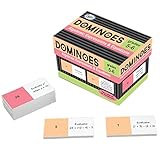
Domino games feel like play, not homework. Your 10-12 year old will be building algebraic thinking while having fun with friends, and you'll love watching them naturally grasp expressions and equation
If your kid freezes when they see an algebra problem, these puzzles are a reset button. Forget worksheets for a minute. With dominoes that snap together as equations, balance scales that let them physically test their guesses, or tiles they can move around to find the answer, algebra becomes something they can actually touch and adjust. They're not reading about balance—they're doing it.
The real payoff? Kids start seeing the logic instead of just the x. They experiment, make mistakes without penalty, and figure out the pattern themselves. That's confidence-building in a way a worksheet never is. Parents looking to fill the gap between "I don't get it" and actual understanding will find solid options here. Skip the flimsy cardboard versions—invest in the sturdy ones that survive actual use.
Age Recommendations
Ages 10-11: Begin with magnetic tiles or domino games. At this age, your child needs to see and touch algebra. These tools make abstract concepts concrete and build foundational understanding without intimidation.
Ages 12-13: They're ready for more complexity. Card games, equation games, and tile-based puzzles with multiple steps work beautifully. This is when algebraic thinking really develops, and games keep engagement high.
Ages 14+: Challenge them with strategy-based games like quadratic equation games. They can handle faster-paced, competitive play while deepening their mathematical reasoning and problem-solving skills.
Our Recommended Products

Engage with Algebra: The Quadratic Game
The Algebra Game: Quadratic Equations is a fantastic resource for making algebra come alive for our kids! Perfect for students in grades 7-12, this interactive game fosters collaborative learning and critical thinking. As we work together in small groups, we can watch our learners develop problem-solving skills while enjoying a hands-on approach to quadratic equations. If we are looking to boost our children's understanding and confidence in math, this game is a must-have for our educational toolbox!
Engage with Algebra: The Quadratic Game brings quadratic equations to life through interactive group play, making math a fun, shared adventure that sparks curiosity and confidence.
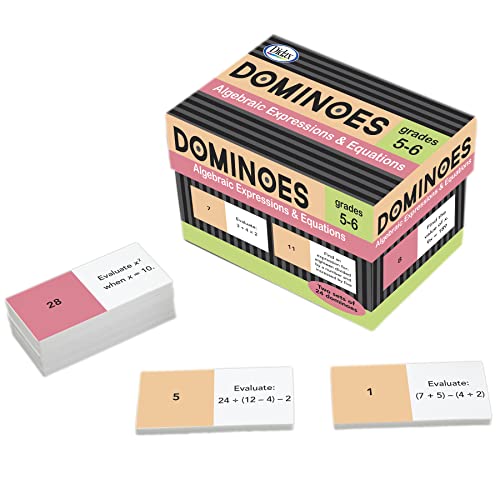
Unlock Algebra Fun with Dominoes!
Didax Educational Resources Algebraic Expressions & Equations Dominoes is an engaging way to make math come alive! These colorful, durable foam dominoes spark joy in learning while reinforcing key algebra concepts for our 5th and 6th graders. Perfect for up to four players, this game turns practice into playtime, allowing students to master expressions and equations with friends and family. Whether you're a parent seeking extra support or an educator looking for a collaborative classroom activity, these dominoes provide a fantastic, hands-on experience that builds confidence in mathematical skills.
Unlock Algebra Fun with Dominoes! offers colorful, durable foam pieces that turn algebraic expressions into a lively game night, making math feel less like homework and more like fun.

Magnetic Algebra Tiles for Engaging Learning
The Learning Resources Magnetic Algebra Tiles are an essential tool for teaching algebraic concepts in an interactive way that resonates with students aged 11 and up. These 72 vibrant magnetic pieces invite hands-on exploration, allowing young minds to visualize and manipulate algebraic equations collaboratively or independently. Ideal for classrooms or home learning, these tiles not only enhance understanding of mathematical principles but also foster critical thinking and problem-solving skills. With a write & wipe surface, students can practice repeatedly, making math a fun and approachable subject!
Magnetic Algebra Tiles for Engaging Learning feature 72 vibrant magnetic pieces that transform algebra into a playful puzzle, making it easier for kids to conquer math concepts without the stress.

Math Teacher Inspired T-Shirt
The PI Math Algebra Calculus Geek Trigonometric Science Teacher T-Shirt is a fun and educational way to celebrate your favorite math enthusiast! This stylish apparel not only expresses a love for math and science but also serves as a conversation starter, encouraging students and friends alike to explore the fascinating world of numbers and equations. Perfect for daily wear or special occasions, it promotes a sense of community around math appreciation and sparks interest in future STEM careers.
Math Teacher Inspired T-Shirt features fun designs that celebrate math, making it a perfect conversation starter to inspire budding mathematicians and future STEM enthusiasts.
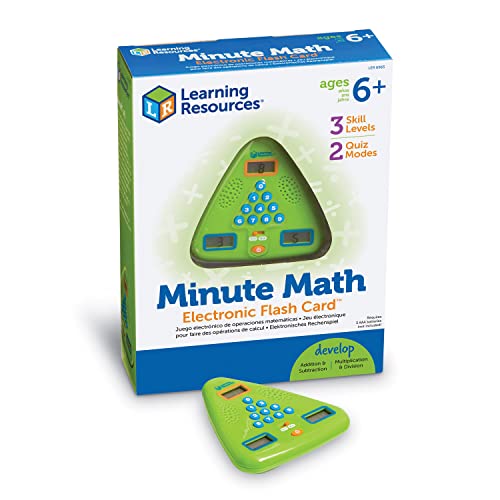
Minute Math Electronic Flash Cards
The Learning Resources Minute Math Electronic Flash Card is an engaging tool for children aged 6 and up, designed to boost early algebra skills in a fun, interactive way. With three difficulty levels, kids can practice essential operations like addition, subtraction, multiplication, and division while having a blast—making math feel less like a chore and more like a game. The color-coded screen frames not only reinforce understanding but also give immediate visual and auditory feedback, helping our young learners feel empowered as they tackle equations. Whether in a homeschool setting or as a supplementary activity, this toy transforms math practice into a joyful challenge!
Minute Math Electronic Flash Cards engage kids with color-coded screen frames that provide instant feedback, making math feel like an exciting game rather than just schoolwork.
Educational Value
Algebra equation puzzles build far more than math skills. When your child works with dominoes that match expressions, or arranges magnetic tiles to balance both sides of an equation, they're developing logical reasoning and pattern recognition—skills that transfer to reading, writing, and every subject that matters.
These hands-on tools also teach persistence. Unlike a worksheet that feels like a test, a puzzle or game invites trial and error. Kids learn that mistakes are information, not failure. They see algebra as a solvable puzzle rather than an impossible task. And when they successfully balance an equation or find that missing number? That confidence ripples into every challenge they face.