Our Top Picks

Perfect for elementary learners who are ready to understand place value and larger numbers. Your child will love stacking and grouping these colorful foam blocks while discovering how math actually wo

A timeless gift that grows with your child from preschool through elementary. Cuisenaire rods are magical for revealing the relationships between numbers, and kids adore the puzzle-like challenge of b

Ideal for your youngest learners who are just beginning their math journey. These bright, tactile number paths turn counting into a joyful game, perfect for building confidence and number recognition
Your second grader dumps a handful of small squares on the table and starts grouping them into tens. No instruction needed—just quiet concentration as she arranges them into neat rows, then swaps ten singles for a rod. Suddenly she gets it. Ten ones *is* a ten. Not because you told her, but because her hands just showed her.
This is where small square manipulatives earn their place in your home. Skip the cheap plastic versions that feel flimsy and break apart. The good ones—wood or sturdy plastic with real weight to them—become tools kids actually want to grab. A four-year-old discovers that five and five make ten. A six-year-old figures out multiplication by building arrays. An eight-year-old solves word problems without frustration because the squares make the story real, not abstract. When learning happens through fingers instead of worksheets, it sticks.
Age Recommendations
Ages 3-4 (Preschool): Start with number paths and dice for fun counting games. Your child is building number recognition and the language of math through play. Keep it short and playful—just a few minutes of exploration creates joy and curiosity.
Ages 5-6 (Kindergarten-Early Elementary): Introduce base ten blocks and Cuisenaire rods. Your child's brain is ready to see how numbers relate to each other. These tools make abstract concepts concrete, helping them understand place value and early addition naturally.
Ages 7+ (Elementary): All of these manipulatives remain valuable for deeper exploration. Your older child can use them for multiplication, division, and problem-solving. They're also wonderful for children who learn visually or need to "see" math concepts.
Our Recommended Products

Engaging Base Ten Math Manipulatives
The hand2mind Green Foam Base Ten Blocks Complete Set is a fantastic resource for teaching math concepts to young learners. This comprehensive set offers children a tactile way to understand place value, addition, subtraction, multiplication, and division, making math less intimidating and more interactive. By using these colorful and proportional blocks, kids can physically manipulate and visualize their understanding of numbers, paving the way for deeper mathematical comprehension and confidence. As educators and parents, we can appreciate how these blocks support small-group learning and provide a hands-on approach to foundational math skills.
Engaging Base Ten Math Manipulatives come as a complete set of colorful foam blocks, turning intimidating math concepts into hands-on fun that kids can visualize and master.

Jumbo Dice Set for Fun Math Learning
Learning Resources Jumbo Dice in Dice, Set of 12, Multi-color are the perfect tool to make math fun and engaging for our little learners! These vibrant, oversized dice are designed for small hands, allowing our kids to physically manipulate their learning as they explore counting, basic operations, and even probability concepts. The colorful exterior cubes invite creative games and activities, making each math session feel like playtime. Let's help our children develop essential math skills while they roll and laugh together!
Jumbo Dice Set for Fun Math Learning features oversized, colorful dice that transform math practice into playful rolling adventures, making numbers come alive for our little explorers.

Connect Math Skills with Cuisenaire Rods
Learning Resources Connecting Cuisenaire Rods Small Group Set is a fantastic tool for helping our children grasp essential math concepts in a fun and colorful way! With 155 vibrant rods in varying lengths, our little learners can explore fractions, measurement, and more while developing their problem-solving skills. The clever design features 1-cm increments on one side, making it easy for our kids to visualize and manipulate numbers. This engaging set not only supports Common Core skills but also fosters creativity and collaboration during group activities. What a wonderful way to spark a love for math!
Connect Math Skills with Cuisenaire Rods includes 155 vibrant rods that make exploring fractions and measurement not just educational, but a colorful adventure for our little learners.
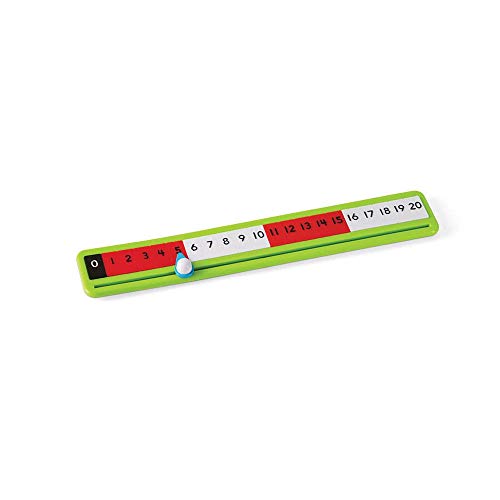
Engaging Number Paths for Young Learners
hand2mind Number Paths are the perfect blend of fun and education! Designed for students, these vibrant, color-coded number lines make counting an engaging experience. With each number path reaching up to 20 and featuring an interactive slider that clicks into place, children will enhance their counting skills and number recognition in no time. Ideal for both classroom settings and homeschool environments, this set is an essential math manipulative that fosters early numeracy skills and supports collaborative learning through small groups.
Engaging Number Paths for Young Learners features interactive sliders that make counting an adventure, ensuring early numeracy skills are developed through playful exploration.
Educational Value
When children manipulate these materials—stacking, arranging, comparing—they're building a foundation that abstract numbers alone can't provide. Base ten blocks make place value tangible. Dice turn probability from a scary word into a game with exciting surprises. Cuisenaire rods show how different quantities relate to each other. Number paths give little learners a visual "road map" for counting and number recognition.
The real advantage? These tools help children move from concrete understanding (I can see and touch 10) to abstract thinking (the number 10 means something). They develop problem-solving skills, spatial reasoning, and the confidence to tackle math challenges. Plus, when learning happens through hands-on exploration, it sticks. Your child remembers what they discovered themselves far better than what they were simply told.