Best Spatial Reasoning Toys for Kids (2026)

Spatial reasoning is the skill you can actually build with the right toy. It's the ability to picture a shape, rotate it in your mind, and see how parts fit into a whole — and it quietly underpins math, geometry, engineering, and the sciences. The research is unusually encouraging: unlike a lot of abilities, spatial sense improves a great deal with practice, and that practice looks exactly like play — building, puzzling, and tinkering.

So we kept only toys that genuinely train picturing-and-rotating — every one from a maker with a real track record, spanning toddler block sets to grade-school brain-benders, with an honest reason behind each choice.

🧸 Curating learning toys since 2004 Independent picks · no pay-for-placement

What "spatial reasoning" actually means — and how toys build it

Strip away the jargon and spatial reasoning is three concrete moves: visualizing a shape you can't see in full (what does the back of this look like?), rotating it in your head to test a fit, and composing small parts into a larger structure. Every toy on this list is really just a machine for practicing one or more of those. Magnetic tiles drill the 2D-to-3D fold; tangrams and pattern blocks drill rotation and composition; marble-maze and roller-coaster builds drill planning a path through space.

The reason this matters beyond the toy box: spatial ability is one of the better predictors of who thrives in STEM, and it's trainable in a way raw "intelligence" isn't. You don't need worksheets or an app — you need open-ended building, a few good shape puzzles, and a child left alone to get stuck and unstuck. Spatial reasoning is one slice of the broader picture; for memory, logic, and early-number skills too, see our cognitive development guide.

Build it: magnetic tiles & blocks

The most direct path to spatial reasoning is building — picturing how flat shapes fold into solids, and how parts combine into a whole. These reward that, and grow with a child for years.

Classic 32-Piece Magnetic Tiles
Editor’s pick · Magna-Tiles

Classic 32-Piece Magnetic Tiles

If spatial reasoning is the goal, this is the toy to buy first. A child lays the squares and triangles flat into mosaics, then has to picture how those same 2D shapes fold up into a 3D box, tower, or house before the magnets click — that mental jump from flat to solid is spatial thinking in its purest form. The genuine tiles hold firmly enough that a structure actually stays standing, which matters: a collapse every ten seconds kills the experimenting. It's open-ended with no wrong build, and the runway is long — flat patterns at three, marble-ramp contraptions at seven. The real tiles cost more than the knock-offs and are worth it; the cheap magnets give up.

Builds: 3D visualization · early geometry · fine motor

~$40· See it on Amazon
Basic Plus 14-Piece Magnetic Shapes Set
Best magnetic geometry · Magformers

Basic Plus 14-Piece Magnetic Shapes Set

Magformers click edge-to-edge and swivel, which makes them a different spatial workout than flat tiles: the magnets rotate, so a kid is constantly turning shapes in their mind to predict how a square will hinge up into a cube. This 14-piece set is the right low-commitment way in, and the inner gears let triangles and squares pop from a flat net into a 3D solid in one satisfying motion — a hands-on demonstration of how faces become a shape. Small enough to be a starter or an add-on to tiles you already own, and the pieces are genuinely sturdy.

Builds: mental rotation · geometry · spatial planning

~$17· See it on Amazon
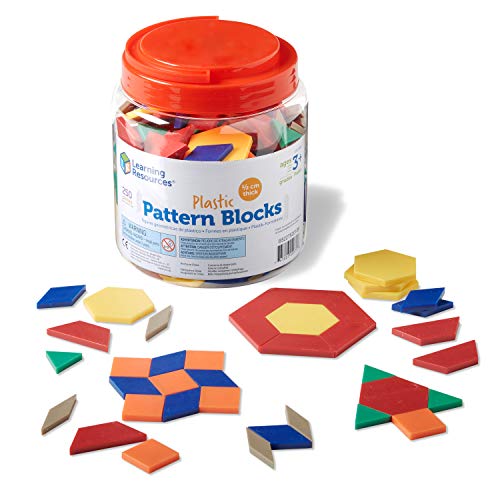
Plastic Pattern Blocks, Set of 250
Best geometry manipulative · Learning Resources

Plastic Pattern Blocks, Set of 250

The quietest powerhouse on this list, and a classroom staple for a reason. The six shapes are sized so they fit together exactly — two trapezoids make a hexagon, three triangles make a trapezoid — so a child physically discovers how shapes compose and decompose, which is the bedrock of spatial sense and early fractions. Kids build symmetrical mandalas, fill outlines, and invent tessellations, all of it real geometry that feels like play. 250 pieces is enough for two kids to build side by side without fighting over the yellow hexagons. Pair it with the design cards below.

Builds: shape composition · symmetry · fractions

~$17· See it on Amazon
Pattern Block Design Cards
Best companion challenge · Learning Resources

Pattern Block Design Cards

Pattern blocks are open-ended, but young kids often need a target — and that's what these double-sided cards add. One side shows the picture with the block outlines drawn in, so a four-year-old can match shape-to-shape; flip it over and the outlines vanish, forcing the child to figure out which shapes fill the silhouette on their own. That second side is where the real spatial problem-solving lives. A cheap, high-leverage add-on that turns a tub of blocks into a progression a child can climb.

Builds: shape matching · visual problem solving · persistence

~$12· See it on Amazon

See it & rotate it: classic spatial puzzles

Mental rotation — turning a shape over in your mind to see if it fits — is the core spatial skill. These train it the old-fashioned, screen-free way.

Tangrams Classpack
Best classic spatial puzzle · Learning Resources

Tangrams Classpack

Tangrams are a thousand-year-old spatial workout that still holds up. Seven flat pieces, one rule — use them all to fill a shape — and the only way through is to rotate and flip the pieces in your head until they fit. That mental rotation is exactly the skill spatial-reasoning research cares about, and tangrams train it with nothing but cardboard-simple parts. This classpack has enough sets for a group, so siblings can each work a silhouette. Print or buy a challenge book and the difficulty goes as deep as you like.

Builds: mental rotation · shape combination · visual reasoning

~$18· See it on Amazon
Mental Blox 3D Building Game
Best mental-rotation game · Learning Resources

Mental Blox 3D Building Game

This one targets spatial reasoning head-on. A card shows a 3D structure built from the chunky blocks, and the child has to recreate it — or answer questions like which block is hidden behind another, or what the stack looks like from the other side. That's mental rotation and spatial visualization as the actual game, not a side effect. The 20 challenge cards span easy copying to genuinely tricky perspective-taking, and there's a memory variant that adds a working-memory twist. A strong pick for the five-to-eight-year-old who's ready to think in three dimensions.

Builds: 3D visualization · spatial memory · logical reasoning

~$26· See it on Amazon
The Original 3x3 Cube
Best mental-rotation classic · Rubik’s

The Original 3x3 Cube

The most famous spatial puzzle ever made, and still a brilliant one. Twisting the cube forces a kid to track how faces rotate and where pieces travel in three dimensions — pure mental rotation, plus the spatial memory to remember a sequence of turns. It's genuinely hard, so set expectations: most kids learn it from a beginner's method or a video rather than solving it cold, and that's fine — working through the algorithms is its own spatial-thinking win. Pocket-sized, screen-free, and a rite of passage for the patient eight-or-up crowd.

Builds: mental rotation · spatial memory · sequencing

~$12· See it on Amazon

Plan it in 3D: logic builds & mazes

Spatial reasoning isn't just shapes; it's planning a path or a structure through space before you commit. These blend visualization with problem-solving.

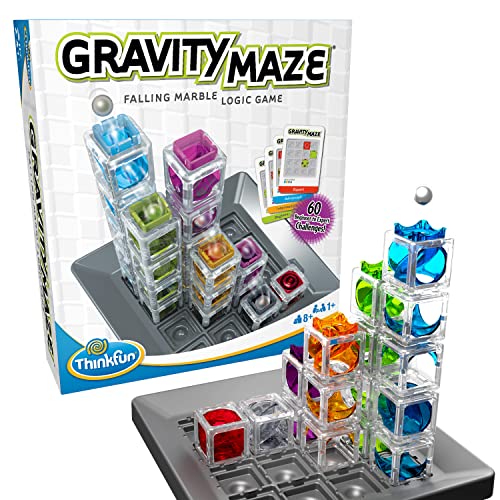
Gravity Maze Falling Marble Logic Game
Best build-and-solve · ThinkFun

Gravity Maze Falling Marble Logic Game

Part logic puzzle, part marble run, and one of the best spatial toys going. You place clear towers so a dropped marble threads through them and lands on the target — which forces a kid to picture the marble's hidden path through the stack in three dimensions before they ever release the ball. The 60 challenge cards climb from gentle to seriously brain-bending, so it grows across years rather than getting solved in a weekend. It overlaps our cognitive-development guide for good reason: this is where spatial visualization and planning meet.

Builds: 3D path planning · spatial reasoning · problem solving

~$20· See it on Amazon
Roller Coaster Challenge STEM Building Game
Best 3D engineering · ThinkFun

Roller Coaster Challenge STEM Building Game

A spatial-engineering puzzle disguised as the coolest toy in the room. Each of the 40 challenge cards fixes where posts and track must start and end, and the child has to build a working roller coaster up and through the constraints — visualizing how the vertical posts and sloping track will occupy the space before committing — then send a car down to prove it holds. It's planning, trial-and-error, and 3D spatial reasoning rolled into something a six-year-old wants to keep doing. A TOTY Game of the Year finalist.

Builds: spatial planning · 3D construction · persistence

~$38· See it on Amazon
Rush Hour Junior Traffic Jam Logic Game
Best sliding-block puzzle · ThinkFun

Rush Hour Junior Traffic Jam Logic Game

Sliding-block puzzles are a spatial-reasoning classic, and Rush Hour is the best of them. The grid is a gridlocked parking lot; the child slides cars and trucks so the target vehicle can escape — which means tracking how each piece's position blocks or frees the others, a spatial relationship that shifts with every move. The Junior edition pitches it at a five- or six-year-old with 40 stacked challenge cards, so wins come fast and then get genuinely hard. Single-player, self-contained, and it travels beautifully.

Builds: spatial awareness · sequential planning · logical reasoning

~$23· See it on Amazon
Kanoodle 3D Brain Teaser Puzzle
Best travel spatial puzzle · Educational Insights

Kanoodle 3D Brain Teaser Puzzle

The pocket-sized spatial puzzle that quietly eats car rides and waiting rooms. Kids fit the linked beads into the tray so every space is filled — a 2D packing puzzle that flips to 3D pyramid builds in the harder challenges, both of which are about seeing how oddly-shaped pieces nest together. The 200 challenges ramp from "oh, got it" to "okay, how," with no batteries and nothing to lose in a clip-shut case. The reason it's a perennial: a child plays it entirely alone and stays stuck-then-satisfied, which is the whole point.

Builds: shape fitting · spatial reasoning · persistence

~$11· See it on Amazon

How much to spend

You really don't need to spend much to build this skill. Several of the most effective toys here are around $11–18Kanoodle, the Rubik's Cube, tangrams, and a tub of pattern blocks all punch far above their price. The $20–26 sweet spot (Gravity Maze, Rush Hour Junior, Mental Blox) is where most generous gifts land. The two splurges worth it are a Magna-Tiles set — it lasts so many years the cost-per-play is tiny — and the Roller Coaster Challenge, which has years of escalating builds in the box.

Frequently asked questions

What toys help develop spatial reasoning skills?
The most effective are building toys and shape puzzles that make a child picture how parts fit and rotate. Our top pick is Magna-Tiles — magnetic tiles that force the leap from flat 2D shapes to 3D structures. For a full spatial workout, mix the types: a magnetic-building set (Magna-Tiles or Magformers), a geometry manipulative (pattern blocks or tangrams), a mental-rotation puzzle (Rubik’s Cube or Mental Blox), and a plan-it-in-3D logic build (Gravity Maze or Roller Coaster Challenge). Every toy here comes from an established maker like Magna-Tiles, Learning Resources, or ThinkFun.
What exactly is spatial reasoning, and why does it matter?
Spatial reasoning is the ability to picture, rotate, and manipulate shapes and objects in your mind — imagining how a flat net folds into a box, or how a puzzle piece would fit if you turned it. It is one of the strongest predictors of later success in math, geometry, engineering, architecture, and the sciences, and unlike many abilities it improves markedly with practice. The good news: the practice looks exactly like play — building, puzzling, and tinkering all train it directly.
At what age should kids start spatial-reasoning toys?
Earlier than you might think. Open-ended building like Magna-Tiles and chunky pattern blocks works from age 3, when a child is first stacking and composing shapes. Tangrams and pattern-block design cards land around 4 to 5. Structured spatial logic — Rush Hour Junior, Gravity Maze, Mental Blox — fits at 5 to 6, and the harder mental-rotation challenges like Rubik’s Cube and the original Roller Coaster Challenge shine from 7 or 8 up. Match the toy to where your child is, not just their birthday.
Are magnetic tiles really good for spatial skills, or just fun?
They are genuinely good — and that is why they top this list. The spatial payoff is specific: a child lays tiles flat in 2D, then has to visualize how those same shapes will fold up into a 3D box or tower before building it, which is exactly the 2D-to-3D translation spatial reasoning is about. Open-ended play with no single right answer also encourages experimenting and mental prediction. Buy genuine tiles, though: weak knock-off magnets let structures collapse, which frustrates kids out of the very experimenting that builds the skill.
Do spatial-reasoning toys overlap with STEM and cognitive toys?
Yes, heavily — spatial reasoning is one branch of cognitive development and a backbone of STEM. A toy like Gravity Maze is all three at once: it trains spatial visualization (cognitive), through a marble-physics build (STEM), as a single-player logic puzzle. This guide focuses on the toys that most directly build the picture-it-and-rotate-it skill; for the broader thinking-skills picture, see our cognitive development guide, and for hands-on science, our STEM picks.

How we choose — and a word on the links

Educational Toys Planet has specialized in learning toys since 2004. We pick independently, only from established makers, then cross-check every candidate against current availability and the major independent award and expert lists. We don't accept payment for placement.

Affiliate disclosure: the product links here are Amazon Associate links. If you buy through them we may earn a small commission at no extra cost to you — that's what keeps these guides free and updated. Prices change; tap through for Amazon's current figure. Last updated June 2026.

Related guides