

Best Musical Toys & Instruments for Kids (2026)

Music is one of the best things you can hand a small child. Banging a drum, tapping out a scale, or strumming a real string teaches rhythm, pitch, and cause-and-effect — and it's pure joy. The trap is the toy aisle, which is full of plastic boxes that blink and sing at your child while they just watch.

So we kept only real instruments and well-made sets — every one from a maker with a track record, with a genuine reason (and an honest word about the noise) behind each pick.

🧸 Curating learning toys since 2004 Independent picks · no pay-for-placement

What makes a musical toy worth buying

The single best filter is simple: does the child make the sound, or does the toy? A wooden xylophone, a hand drum, a ukulele — these go quiet until a small person strums, taps, or blows. That's where the learning lives. Keeping a steady beat is the foundational musical skill and quietly builds the timing that later helps with reading and math; pressing keys and plucking strings builds the same fine-motor strength as handwriting practice; and a harmonica teaches breath control through nothing but a child's own lungs.

Match the instrument to the hands. Around a year, kids want shakers and a simple drum — things to grab and bang. By two or three they can handle a xylophone or a whole band set and start finding a beat. By four or five, fingers are ready for a real first melody — a ukulele, a harmonica, or a color-coded piano they can read along to. The best musical gift isn't the one with the most flashing lights; it's the one that hands a child something real to play.

Best all-in-one music sets

The fastest way to a musical household is a set — several real instruments in one box, so a child can find the one that clicks and a roomful of kids can form a band. These three are where most families should start.

Pound, Tap & Shake! Music Set
Editor’s pick · Hape

Pound, Tap & Shake! Music Set

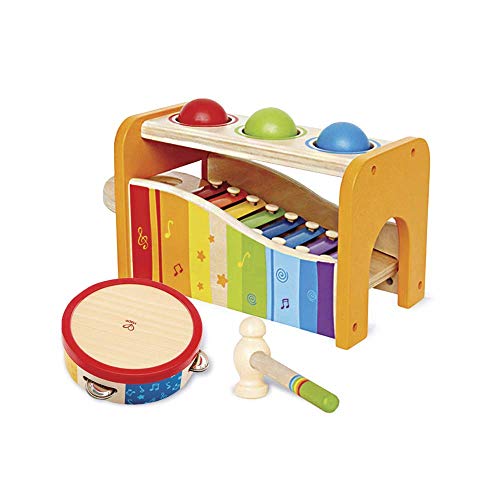
If you buy one musical toy for a toddler, this is the one. It bundles three real first instruments — a pound-through bench, a slide-out xylophone, and a tap-along tambourine — so a one-to-three-year-old gets hammering, melody, and shaking in a single box. The genius is the pounding bench: knock the balls through the top and they roll down the xylophone keys, playing notes on their own, which is the first "I made that sound happen" moment that hooks kids on music. It's solid wood, sized for small hands, and survives years of enthusiastic abuse. The mallet wanders off eventually — a wooden spoon fills in fine.

Builds: rhythm · cause & effect · hand-eye coordination

~$36· See it on Amazon
Make a Melody Wooden Instrument Set
Best starter band · B. toys

Make a Melody Wooden Instrument Set

Nine real wooden instruments in a drawstring bag — xylophone, tambourine, harmonica, clackers, and more — which is exactly what you want when more than one kid is in the room. It turns a playdate into a kitchen-floor band, and the variety means a child can find the instrument that clicks for them instead of being handed one and told to like it. Everything packs back into the bag, which is the only reason a set with this many pieces survives. Honest heads-up: nine instruments means nine kinds of noise, so set a "band practice is over now" rule early.

Builds: rhythm · turn-taking · sound exploration

~$27· See it on Amazon
Band-in-a-Box: Clap! Clang! Tap!
Best value set · Melissa & Doug

Band-in-a-Box: Clap! Clang! Tap!

A ten-piece percussion set from the brand that practically defines durable wooden toys, and it's the best money in this guide. Cymbals, a tambourine, a clacker, a maraca, a triangle — the classic rhythm-band lineup that preschools actually use, at a price that makes it an easy birthday-party gift. The pieces are chunky and well-finished, and because it's all percussion there's nothing to tune or break. It's aimed at threes and up, which makes it a notch more grown-up than the toddler pound-benches above.

Builds: rhythm · coordination · group play

~$19· See it on Amazon

Real first instruments

Toys that teach by making the child do the work — strumming, drumming, blowing, tapping out a melody. They sound like actual instruments because they basically are, scaled down for small hands.

Caterpillar Xylophone
Best first melody · Melissa & Doug

Caterpillar Xylophone

The cheapest real instrument here and a genuinely lovely one. The metal bars are tuned well enough that the notes actually sound musical rather than clangy, and the rainbow caterpillar shape invites a toddler to bang up and down the scale and hear pitch climb and fall. It rolls on little wheels, so it doubles as a pull toy. At this price it's the perfect "let's see if they like music" purchase before you commit to a bigger set — and it holds up to plenty of mallet-pounding.

Builds: pitch awareness · fine motor · cause & effect

~$11· See it on Amazon
Wooden Toy Ukulele (21-Inch)
Best first strings · Hape

Wooden Toy Ukulele (21-Inch)

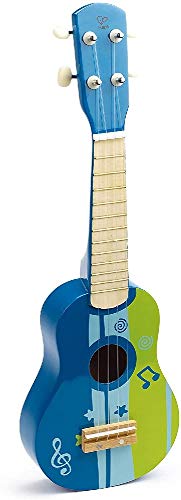
A surprisingly real little ukulele — wooden body, four nylon strings that genuinely tune and hold a note, sized right for a three-to-five-year-old's arms. It's not a toy that makes sound for them; they have to strum and press, which is a different and more rewarding kind of play than pushing a button. Will it stay in tune through a toddler's handling? Roughly. But it's the toy that lets a kid feel like a real musician, and for a few that spark turns into actual lessons later. A small tuner clip helps a lot.

Builds: fine motor · pitch awareness · patience

~$19· See it on Amazon
First Musical Guitar (26-Inch)
Best for older kids · Hape

First Musical Guitar (26-Inch)

A step up from the ukulele: a full 26-inch wooden guitar with six tunable nylon strings, built for the three-to-six-year-old who keeps reaching for the grown-up's instrument. It has a real, warm strum — not a tinny rattle — and the scale is sized so small hands can actually reach across the neck. This is a splurge, and it's the right one for a child who's shown real, repeated interest in playing rather than just making noise. Like any stringed toy it needs an occasional tune, so factor in a clip-on tuner.

Builds: fine motor · rhythm · confidence

~$45· See it on Amazon
Junior Percussion Set (3-Piece)
Best for toddlers · Hape

Junior Percussion Set (3-Piece)

Three real wooden percussion instruments — a clatter, a rattle, and a tone block with mallet — chosen so a twelve-month-old can grab, shake, and bang without anything to swallow or break. It's the gentlest on-ramp to "playing music," and the wood feels and sounds far nicer than the plastic rattles most babies get. Small enough for the diaper bag, sturdy enough to throw, and a good way to learn that different motions make different sounds before a child is ready for a whole band set.

Builds: rhythm · grip strength · coordination

~$20· See it on Amazon
Double-Sided Drum
Best drum · Hape

Double-Sided Drum

A proper little wooden hand drum with two playable heads in different tones, plus a mallet on a cord so it doesn't immediately vanish. Drumming is where a lot of toddlers first feel a steady beat in their body — the most foundational musical skill there is — and a real drum head sounds and responds in a way a plastic bucket never will. It's loud, which is the entire point and also your warning. Sturdy enough to take real whacks; the attached mallet is a small mercy.

Builds: rhythm · beat-keeping · coordination

~$22· See it on Amazon
Blues Harmonica (Wooden, 10-Hole)
Best stocking stuffer · Hape

Blues Harmonica (Wooden, 10-Hole)

A real ten-hole harmonica with a wooden comb, scaled and priced for small hands and small budgets. Wind instruments are wonderful for little kids because the sound comes from their own breath — blow and draw and the note changes, which is immediate, physical cause-and-effect they control completely. It teaches breath control that's genuinely useful, fits in a coat pocket, and costs about as much as a fancy coffee. The obvious caveat: it only works if you're okay with harmonica noise in the back seat.

Builds: breath control · pitch awareness · cause & effect

~$12· See it on Amazon

Keyboards & a smarter battery toy

Where music meets early academics: picking out notes, reading a color-coded songbook, and the one electronic toy here that lets a child play rather than just press.

Crocodile Animal Keyboard Piano
Best electronic · Battat

Crocodile Animal Keyboard Piano

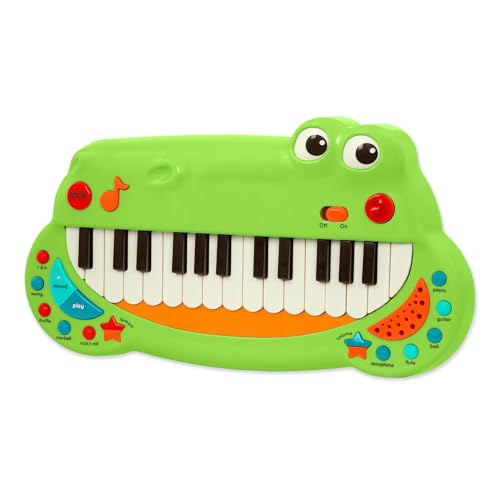
The battery toy that earns its spot. Most light-up musical toys do the playing for the child; this little keyboard has five real modes — including a plain piano voice — so a two-year-old can actually pick out notes and hear that this key is higher than that one. The animal sounds and demo songs are the hook, but the piano mode is where real musical learning happens. A sensible middle ground for the family that wants something electronic without the usual relentless blinking-and-singing chaos.

Builds: pitch awareness · cause & effect · early melody

~$30· See it on Amazon
Learn-to-Play Piano with Songbook
Best for real lessons · Melissa & Doug

Learn-to-Play Piano with Songbook

A 25-key wooden piano with a color-coded songbook, built for the four-or-five-year-old ready to actually play a tune rather than just bang. The keys match colored dots in the book, so a child can pick out "Twinkle, Twinkle" by following along — a real first taste of reading and playing music together. It's an acoustic piano (no batteries, no volume knob), so the sound is honest and a little quiet, which most parents count as a feature. The closest thing here to a stepping stone toward actual lessons.

Builds: note reading · pitch awareness · fine motor

~$30· See it on Amazon

A frank word on the noise

Let's be honest: every toy on this list makes noise — that's the whole idea. The trick is choosing the right kind. Acoustic instruments (the xylophone, drum, or wooden piano) are loud but not relentless — they stop the second your child does. Battery toys add looping songs and jingles that play on their own. If quiet matters, lean acoustic, keep band sets in a bin for "music time," and send the drums and harmonicas outside.

How much to spend

You don't need to spend much to start a musician. Several of the best toys here are under $20 — the Caterpillar Xylophone (~$11), the harmonica (~$12), the Band-in-a-Box set (~$19), and the wooden ukulele (~$19) all punch above their price. The $20–36 range (the Hape music set, Make a Melody, the drum, and the keyboard) is where most generous birthday gifts land. The one splurge worth it is the 26-inch Hape guitar (~$45) — and only for the child who keeps reaching for the real thing.

Frequently asked questions

What are the best musical toys for toddlers and preschoolers?
For a first musical toy, the Hape Pound, Tap & Shake! Music Set is our top pick — it combines a pound bench, xylophone, and tambourine so a toddler gets three kinds of play in one box. For a roomful of kids, a multi-instrument set like the B. toys Make a Melody or the Melissa & Doug Band-in-a-Box gives everyone something to play. For a single real instrument, the Melissa & Doug Caterpillar Xylophone (around $11) and the Hape Wooden Ukulele are both genuinely musical and built for small hands. Every toy in this guide comes from an established maker like Hape, Melissa & Doug, B. toys, or Battat.
Are wooden instruments better than electronic musical toys?
For most kids, yes — and it comes down to who is doing the work. A wooden xylophone, drum, or ukulele makes sound only when the child strums, taps, or blows, so they learn real cause-and-effect, rhythm, and pitch. Many electronic toys play songs and light up on their own, which entertains but teaches the child less. That said, a well-designed electronic keyboard with a true piano mode (like the Battat Crocodile Piano) lets a child actually pick out notes. As a rule, the more a toy performs by itself, the less your child is practicing.
What age should a child get their first instrument?
Around 12 months a baby is ready for shakers, a tone block, or a simple drum — anything they can grab and bang, like the Hape Junior Percussion Set. By 2 to 3 they can handle a xylophone, tambourine, or a multi-instrument band set and start keeping a rough beat. By 4 to 5, fine motor skills are good enough for a real first melody instrument — a ukulele, a harmonica, or a color-coded learn-to-play piano. Match the toy to the hands: small graspable percussion first, melody and strings later.
Do musical toys actually help child development?
They genuinely do. Keeping a beat builds the same timing and coordination that later support reading and math; strumming and pressing keys build fine-motor strength; and blowing a harmonica builds breath control. Just as much, music is social and emotional — a band set teaches turn-taking, and playing a tune a child recognizes builds confidence and joy. The catch is that the benefit comes from active playing, not passive listening, so the best musical toys are real instruments the child has to operate themselves.
How do I survive the noise of musical toys?
A few honest tactics: choose acoustic over electronic where you can — a wooden xylophone or drum is loud but not relentless, while battery toys add looping songs and jingles. Keep band sets in a bin and bring them out for "music time" rather than leaving everything underfoot all day. And lean into the loudest instruments (drums, harmonicas) outdoors or in the basement. The noise is the point — it means your child is making music — but a little containment keeps everyone sane.

How we choose — and a word on the links

Educational Toys Planet has specialized in learning toys since 2004. We pick independently, only from established makers, then cross-check every candidate against current availability and the major independent award and expert lists. We don't accept payment for placement.

Affiliate disclosure: the product links here are Amazon Associate links. If you buy through them we may earn a small commission at no extra cost to you — that's what keeps these guides free and updated. Prices change; tap through for Amazon's current figure. Last updated June 2026.

Related guides