Best Toys That Teach Animal Sounds (2026)

“The cow says… moo.” For a lot of kids, animal sounds are the first language they crack — "moo," "baa," and "woof" often arrive before real words, because they're simple, silly, and irresistible to copy. The right toy turns that instinct into real learning: vocabulary, listening, and the dawning idea that my action makes that sound happen.

So we kept only toys we'd actually hand a toddler — every one from a maker with a real track record, from the lever-pull See ’n Say their grandparents remember to modern sound puzzles, with a genuine reason behind each pick (and a note on which ones are loud).

🧸 Curating learning toys since 2004 Independent picks · no pay-for-placement

What makes an animal-sound toy actually teach

The difference between a great animal-sound toy and a noisy one comes down to a single question: who's doing the work? A toy that just plays a loop teaches a toddler to be an audience. A toy where the child pulls a lever, points a dial, presses a key, or drops a puzzle piece into its slot makes them the cause — and that "I did that" feedback is the engine of early learning. Every pick here was chosen because the child operates it, not the other way around.

It helps to picture what a one- or two-year-old is practicing. They're matching a sound to a name (vocabulary), noticing that a cow and a sheep sound different (listening discrimination), and learning that their hands change the world (cause and effect). The best of these toys layer a second skill on top — a puzzle to solve, gears to spin, a quiz that asks "can you find the pig?" — so one press does double duty. And because toddlers repeat the same delightful action hundreds of times, durability and a volume control matter more than any feature on the box.

The classic “animal says…” toys

Point, press, or pull — and a voice tells you what the animal says. These are the purest sound-teachers, and the See ’n Say is the one nearly every parent remembers from their own childhood.

Classics Farmer Says See ’n Say
Editor’s pick · Fisher-Price

Classics Farmer Says See ’n Say

This is the toy most parents picture when they hear "animal sounds" — and it's a faithful reissue of the lever-pull See ’n Say that's been teaching toddlers since the '60s. You point the arrow at a cow, pull the lever, and a real voice says "The cow says… mooo." The magic is that it's mechanical, not a screen: a one-year-old can work the lever, the pointer, and the sound entirely on their own, which is exactly the kind of "I did that" feedback that drives early learning. It's louder and chunkier than the newer versions, and the lever is the part kids fall in love with.

Builds: animal sounds · cause & effect · listening

~$23· See it on Amazon
Little People See ’n Say The Farmer Says
Best modern version · Fisher-Price

Little People See ’n Say The Farmer Says

The same farmer-says idea brought up to date — a turn-dial instead of a lever, plus little songs and a quiz mode that asks "Can you find the pig?" That question-and-find layer is what nudges a toddler from just hearing the sound to actually identifying the animal, which is the real skill underneath. It's lighter and a touch quieter than the Classics version, and the dial suits smaller hands. If you want one See ’n Say and a slightly younger child, this is the friendlier pick.

Builds: animal sounds · fine motor · turn-taking

~$19· See it on Amazon
100 Animals Book
Best vocabulary builder · LeapFrog

100 Animals Book

Far more than a sound button — this is a sturdy interactive book with a hundred animals across habitats, and tapping each one names it, makes its sound, and shares a quick fact. It quietly does the heavy lifting on vocabulary: a toddler hears "tiger," the roar, and "tigers live in the jungle" in one tap, and it'll do English and Spanish. The pages are thick board-book tough, so it survives the tapping-and-flipping a curious one-year-old dishes out. It's the pick for the kid who wants more animals than a farm set can hold.

Builds: animal names · animal sounds · two languages

~$25· See it on Amazon

Sounds you make happen

Toys that pair the animal sound with a real job for little hands — pressing keys, spinning gears, dropping puzzle pieces — so a toddler is building fine motor and cause-and-effect at the same time.

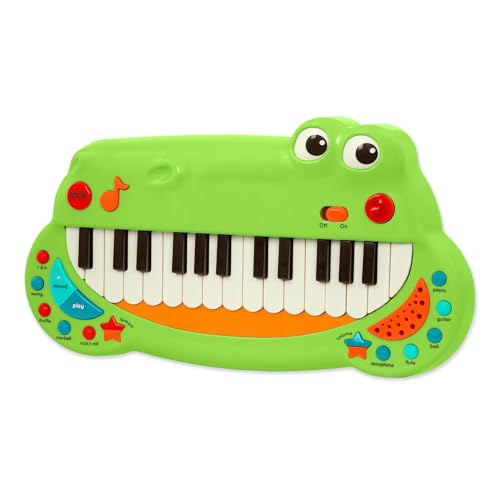
Animal Keyboard Piano (Crocodile)
Best music + sounds · Battat

Animal Keyboard Piano (Crocodile)

A grinning crocodile piano with five modes — and one of them turns every key into an animal sound, so the same instrument that plays notes also moos, baas, and quacks. Toddlers love that one press does something every time, and switching between "real piano" and "animal mode" keeps it fresh far longer than a single-trick toy. It's genuinely musical too, so it grows into a first instrument once the novelty of the sounds wears in. Note it's on the louder side — there's a volume control, and you'll use it.

Builds: animal sounds · cause & effect · rhythm

~$30· See it on Amazon
Mooosical Gears
Best hands-on · B. toys

Mooosical Gears

Spinning gears meet farm animals: a toddler snaps the cow, pig, sheep, and rooster gears onto the pegboard, gives one a spin, and the whole set turns while music and animal sounds play. It pairs the sound-learning with a real fine-motor job — lining up and pressing on the gears — so little hands are busy, not just a finger on a button. The animals pop off and become characters in their own right, which is half the play. It's the priciest farm-sound toy here, but it does three things (gears, music, animals) at once.

Builds: animal sounds · fine motor · cause & effect

~$39· See it on Amazon
Laugh & Learn Farm Animal Puzzle
Best for sorting · Fisher-Price

Laugh & Learn Farm Animal Puzzle

Five chunky animal pieces drop into their matching slots, and each correct placement is rewarded with the animal's name, sound, and a little song. It marries two toddler milestones at once — the shape-sorting "where does this go?" puzzle and the "what does it say?" sound learning — so a child gets a double hit of feedback for one action. The pieces are toddler-thick and easy to grab, and it works as a flat puzzle even with the sounds off. A tidy, affordable pick for the 1-to-2 crowd.

Builds: animal sounds · shape matching · first words

~$20· See it on Amazon

Sound-and-song for the littlest ones

Brighter, simpler, and budget-friendly — built for babies and young toddlers still learning that pressing a button makes something happen.

Pop and Sing Animal Train
Best for little ones · VTech

Pop and Sing Animal Train

Press the animal-shaped buttons and they pop up while the train names the animal, plays its sound, and rolls along with songs. The pop-up mechanism is the hook — it adds a satisfying physical "boing" to each press, so the cause-and-effect lands harder for a baby or young toddler still learning that their actions make things happen. Beyond sounds it sneaks in colors and counting, and it's a push-along ride once they're up and crawling. Skews younger (roughly 6–36 months), so it's a strong first-birthday gift.

Builds: animal sounds · colors · counting

~$20· See it on Amazon
Sing ’n Play Maracas
Best under $10 · CoComelon

Sing ’n Play Maracas

Two light-up maracas with three modes, one of which calls out animal sounds and colors between song clips. For the price of a coffee or two, it's the easiest way to add sound-and-shake play to the mix, and the CoComelon songs are catnip for the toddlers who already love the show. It's not a deep toy — it's a cheerful, grab-and-go noisemaker — but it travels well and gives a one-year-old something to rattle along to. A good stocking stuffer or add-on, not a centerpiece.

Builds: animal sounds · rhythm · colors

~$6· See it on Amazon
Laugh & Learn Smart Stages Puppy
Best plush · Fisher-Price

Laugh & Learn Smart Stages Puppy

A soft, huggable puppy whose paws, ears, and heart trigger songs, words, and yes — puppy sounds, with content that levels up as your child grows (the "Smart Stages" part). It's the cuddly counterpoint to all the hard-plastic toys here: a child can carry it around, nap with it, and still get the bark-and-learn payoff. The leveling means it stays useful from about six months past toddlerhood, since the phrases get more advanced as you flip the stage switch. A warm, safe first "animal that talks back."

Builds: animal sounds · body parts · first words

~$20· See it on Amazon

A pet that talks back

For the child who's outgrown farm buttons and wants something that reacts to them.

Higgle the Hedgehog
Best interactive pet · Curlimals

Higgle the Hedgehog

A small plush hedgehog that giggles, talks, and reacts to being petted, tickled, or rolled — over fifty sounds and responses in all. It's a step up from a single-sound toy: kids learn that different actions get different reactions, which is a real cause-and-effect lesson dressed up as a pet. The curling-up "react when you touch it" trick is genuinely charming and earns repeat play. Aimed a bit older (3+), so it's the pick once a child has graduated from farm-button toys and wants a pet that responds to them.

Builds: cause & effect · pretend play · social play

~$20· See it on Amazon

How much to spend (and a word on noise)

You really don't need to spend much here. The CoComelon maracas come in around $6, and the everyday workhorses — the Little People See ’n Say, Farm Animal Puzzle, VTech train, and Laugh & Learn Puppy — all land near $20. A Classics See ’n Say or LeapFrog book around $23–25 makes a generous gift, and the Mooosical Gears is the one splurge — it does the work of three toys.

One honest caveat: these toys make noise — that's the whole point. If a quieter house matters, favor the picks with a volume switch (the Battat keyboard and the Laugh & Learn toys), and know that the mechanical Classics See ’n Say is the loudest of the lot with no way to turn it down. A small piece of tape over the speaker is the classic parent fix.

Frequently asked questions

What are the best toys for teaching animal sounds?
The classic is the Fisher-Price See ’n Say — both the retro Classics lever version and the modern Little People dial version teach the "the cow says moo" pattern with a single, satisfying action a toddler can do alone. For range, the LeapFrog 100 Animals Book covers far more creatures than a farm set, and toys like the Battat Animal Keyboard or B. toys Mooosical Gears add hands-on play. Mix one "animal says" toy with one hands-on one and you’ve covered both listening and fine motor.
At what age do toddlers learn animal sounds?
Most children start mimicking animal sounds between about 12 and 18 months — often "moo," "baa," and "woof" come before many real words, because the sounds are simple and fun to copy. That makes the first and second birthdays the sweet spot for these toys. A See ’n Say or sound puzzle suits an 18-month-old well; a younger baby (6–12 months) does better with a simpler press-and-pop toy like the VTech Animal Train.
Are animal-sound toys actually educational, or just noisy?
The good ones are genuinely educational — they teach vocabulary (the animal’s name), cause and effect (my action makes the sound), and listening discrimination (a cow and a sheep sound different). The key is whether the child does the work: a toy where they pull a lever, point a dial, or drop a puzzle piece is teaching far more than one that just plays on a loop. As a rule, the more the child operates it, the more they learn — and the less it babbles on its own, the better.
How do I keep these toys from being too loud?
Buy ones with a volume switch — most picks here (the Battat keyboard, the Laugh & Learn toys) have at least a two-level control, and that solves most of it. For toys without one, a small piece of tape over the speaker grille takes the edge off noticeably. The mechanical Classics See ’n Say is the loudest of the bunch and has no volume control, so skip it if a quieter house matters to you; the Little People dial version is gentler.
Do these need batteries?
Most do — the See ’n Say (Little People version), LeapFrog book, Battat keyboard, VTech train, CoComelon maracas, and the Laugh & Learn toys all run on batteries, usually AA or AAA, and most include a starter set. The retro Fisher-Price Classics See ’n Say is the exception: it’s fully mechanical, so the lever and voice work with no batteries at all — a genuine plus if you’re tired of dead toys.

How we choose — and a word on the links

Educational Toys Planet has specialized in learning toys since 2004. We pick independently, only from established makers, then cross-check every candidate against current availability and the major independent award and expert lists. We don't accept payment for placement.

Affiliate disclosure: the product links here are Amazon Associate links. If you buy through them we may earn a small commission at no extra cost to you — that's what keeps these guides free and updated. Prices change; tap through for Amazon's current figure. Last updated June 2026.

Related guides