Our Top Picks
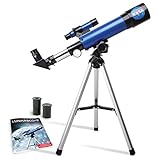
Perfect for 9-year-olds ready for real stargazing. The NASA Lunar Telescope gives your child authentic astronomical experiences—watching craters on the moon and bright planets creates those unforgetta

A game-changer for families. The StarSense Explorer uses smartphone technology to guide your child to stars and planets, making discovery intuitive and frustration-free. Great for building confidence

Wonderful for hands-on learners. Building their own telescope teaches engineering principles while the final product becomes a cherished tool. Your child gains problem-solving skills alongside the pri

Two instruments in one—perfect for curious minds who want variety. Moving between telescope and microscope keeps learning fresh and exciting, revealing wonders both in the sky and right outside your w
Picture this: your child steps outside on a clear night, peers through a telescope, and suddenly gasps—they can actually see craters on the moon. They can spot Jupiter's moons. The universe stops being something in a textbook and becomes real, tangible, thrillingly close. That moment? That's what a good telescope at age nine can create.
This is the sweet spot where kids are old enough to handle real equipment responsibly, but still young enough to be genuinely amazed by discovery. A telescope isn't just an instrument—it's an invitation to wonder. It's the tool that transforms a quiet evening in the backyard into an adventure that might spark a lifelong love of science, or at minimum, create memories you'll both treasure.
Whether you're looking for something hands-on to build together, a talking guide to explore the cosmos, or a smartphone-enabled telescope that bridges tech and astronomy, we've curated options that work for real families. Because the best gift isn't the fanciest one—it's the one that makes your child lean in closer, ask better questions, and see the world as more wondrous than they did before.
Age Recommendations
Ages 5-7: Start with interactive and projection-based telescopes like the GeoSafari Jr. or Space Torch Projector. These don't require fine motor control and work indoors or outdoors. They're perfect for building enthusiasm and basic sky knowledge without frustration.
Ages 8-9: Your child is ready for real stargazing! The NASA Lunar Telescope or Smartivity build-your-own model work beautifully at this age. Kids have the patience for setup and the cognitive ability to understand what they're seeing. Consider app-enabled options if your child enjoys technology.
Ages 10+: Traditional telescopes and more sophisticated models become appropriate. Your child can handle independent operation, understand complex concepts, and appreciate the engineering involved. This is when true astronomy hobbies often begin.
Our Recommended Products

Build and Explore with Smartivity Telescope
The Smartivity Telescope STEM Toy invites kids to ignite their curiosity by constructing their very own pocket telescope. This engaging DIY project not only fosters a love for science but also develops key skills like problem-solving, spatial awareness, and independent thinking, all while keeping screen time at bay. Perfect for both boys and girls aged 8-14, it’s an exceptional way to encourage creativity and confidence in young minds as they embark on their scientific adventures.
Build and Explore with Smartivity Telescope includes everything needed to construct your own pocket telescope, combining hands-on fun with essential STEM learning that sparks curiosity without screens.

GeoSafari Jr. Talking Telescope Adventures
The Educational Insights GeoSafari Jr. Talking Telescope takes kids on an exciting journey through outer space from the comfort of home! Designed for children aged 4 and up, this interactive telescope engages young minds with stunning NASA images and the captivating voice of Emily Calandrelli, offering 240 fun facts that spark curiosity and inspire wonder. It’s not just about seeing the stars; it’s about developing critical thinking and a love for STEM through engaging audio in multiple languages, fostering an appreciation for science in every little explorer.
GeoSafari Jr. Talking Telescope Adventures captivates with engaging audio featuring 240 fun facts, turning stargazing into a fascinating STEM adventure right at home.
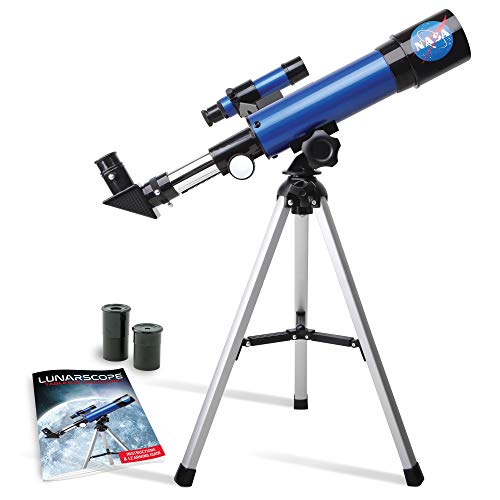
NASA Lunar Telescope: Explore the Moon!
NASA Lunar Telescope for Kids is the perfect companion for budding astronomers eager to explore the night sky! Designed with young learners in mind, this telescope provides incredible 90x magnification that allows children to observe the moon's craters and surfaces in stunning detail. As they navigate through the cosmos, kids will not only develop their observational skills but also nurture their curiosity about space and science. This delightful educational toy encourages hands-on learning, inspires imagination, and can spark future interests in STEM fields—a fantastic investment for every parent's toolkit!
NASA Lunar Telescope: Explore the Moon! offers incredible 90x magnification, turning stargazing into an exploration adventure that inspires young minds to reach for the stars.

GeoSafari Telescope & Microscope Set
The Educational Insights GeoSafari Telescope & Microscope Set is an exciting gateway to the wonders of science for kids aged 8 to 12. This dynamic two-in-one set provides everything young explorers need to fuel their curiosity, from stargazing with the powerful telescope to investigating tiny worlds with the microscope. Perfect for sparking a love for STEM, it helps children develop critical thinking, observational skills, and a fascination for biology, astronomy, and geology. It's not just a toy; it's a toolkit for budding scientists eager to uncover the mysteries of their world!
GeoSafari Telescope & Microscope Set includes both a powerful telescope and a detailed microscope, opening up dual avenues for discovery that ignite a lifelong passion for exploration.

Explore Space with Magic Adventures Telescope
LeapFrog Magic Adventures Telescope is a gateway to the wonders of space right from your backyard! This engaging digital telescope not only allows our little explorers to zoom in on the Moon and beyond with impressive magnification, but it also offers over 100 NASA videos that spark curiosity about the universe. As parents and educators, we know how critical it is to encourage STEM learning and inspire a love for science. With thrilling adventures in a spacecraft game, our children can develop problem-solving skills and a sense of wonder as they ensure vital information reaches Mission Control – all while having a blast!
Explore Space with Magic Adventures Telescope offers over 100 NASA videos to ignite curiosity, making backyard stargazing a launchpad for brilliant minds and quick imaginations.

Explore the Cosmos with StarSense Explorer
Celestron 22481 StarSense Explorer 130mm Tabletop Dobsonian Smartphone App-Enabled Telescope makes stargazing accessible for families and budding astronomers. With its user-friendly StarSense app, you can embark on an educational adventure, discovering dazzling nebulae, vibrant planets, and more—all without needing prior experience! This telescope fosters curiosity and critical thinking as kids learn to identify celestial bodies and understand the night sky, while parents can delight in watching their children develop observation skills and a sense of wonder for science. It's a perfect blend of technology and nature that brings us closer to the universe, together!
Explore the Cosmos with StarSense Explorer lets families discover the night sky through a user-friendly app, turning stargazing into a shared adventure full of wonder and learning.

Explore the Cosmos with Space Torch Projector
Space Torch and Projector is the perfect gateway for young explorers to dive into the wonders of the universe right from their own room! With 24 captivating NASA and Hubble Telescope images, this clever toy not only fuels imagination but also sparks interest in science, technology, engineering, and math (STEM). As our little ones twist the lens to sharpen their view of galaxies and nebulae, they enhance their focus skills and learn about the vast cosmos in an engaging way. Ideal for cozy pyjama parties and sleepovers, this multi-functional projector transforms into a handy flashlight, making bedtime storytelling even more magical.
Explore the Cosmos with Space Torch Projector features 24 captivating NASA and Hubble Telescope images, turning bedtime into an adventure through the stars, all while sneaking in a little science.

X-Scope: Discover & Explore Fun!
The Carson X-Scope Kids 7 Function Multi Purpose Optical Pocket Tool is not just a toy; it's a gateway to discovery! With features like a powerful 30x microscope and an 8x telescope, kids can dive deep into the microscale and gaze at the stars, fostering a love for science and exploration. Each function—like the fold-out magnifier and directional compass—promotes critical thinking, curiosity, and hands-on learning. Packed with a flashlight for night-time adventures and a digital clock, it's a perfect companion for imaginative play while encouraging observational skills and time management.
X-Scope: Discover & Explore Fun! includes a powerful 30x microscope, turning backyard exploration into a thrilling science adventure that's perfect for igniting a love for discovery.

LEGO Friends Stargazing Adventure Set
The LEGO Friends Stargazing Camping Vehicle Adventure Toy is a fantastic way to spark interest in science for kids ages 7 and up. Featuring a buildable 4x4 vehicle, a camping trailer, and accessories that include a telescope, this set encourages learners to explore astronomy while honing their creativity and storytelling skills. With mini-dolls Nova and Aliya, along with their furry friends, children can engage in imaginative role play that fosters social interaction and teamwork. Plus, the added challenge of creating constellations using the planets and stars ignites curiosity and promotes problem-solving skills—making it an exceptional choice for parents seeking educational toys that make learning fun!
LEGO Friends Stargazing Adventure Set includes a telescope, turning camping into a cosmic exploration that fosters curiosity and fuels imaginative play under the stars.
Educational Value
When a child looks through a telescope, they're doing real science. They're practicing observation skills—learning to focus, to be patient, to notice details. They're building spatial reasoning as they understand how distance and perspective work across millions of miles. They're developing critical thinking by asking questions: What am I seeing? Why does it look that way? How far away is it?
Beyond the cognitive benefits, there's something quieter and equally important happening: they're learning that the world (and universe) is bigger and more interesting than they imagined. This kind of genuine curiosity—sparked by personal discovery rather than a lesson—is the foundation for a lifetime of learning. Whether your child becomes an astronomer or simply learns to ask better questions about the world around them, a telescope offers both immediate delight and lasting developmental growth.