

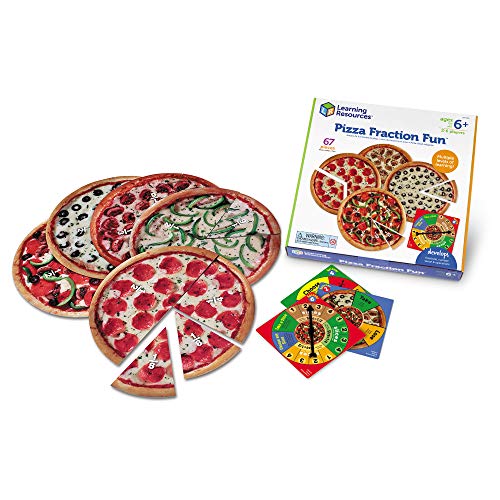
Fractions are often where math stops being fun for kids—suddenly numbers become abstract, and the visual connection disappears. But here's what we've discovered: when children can actually see and hold fractions, something clicks. A half becomes real. A quarter makes sense. And suddenly your child isn't just memorizing rules; they're discovering patterns and relationships on their own.
Fraction circle puzzles and tiles do something special that worksheets simply can't. They let kids manipulate, compare, and experiment. They create those moments where a child's face lights up because they just figured out that two quarters equal one half—without anyone telling them. Whether you're a parent looking to support what's happening in the classroom or a grandparent searching for a gift that keeps on teaching, these colorful, hands-on tools transform fractions from intimidating to intuitive. The right manipulative at the right moment can change a child's entire relationship with math.
Our Recommended Products
Exploring Fractions with Colorful Fun!
hand2mind Plastic Rainbow Fraction Tower Cubes and Fraction Circles are the perfect tools for making fractions come alive for our children! These durable, bright manipulatives invite kids to visualize relationships between fractional parts, helping them grasp complex concepts in a playful manner. As educators and parents, we appreciate that these engaging materials support hands-on learning, making it easier for students in grades 4-12 to master fractions while developing critical thinking and problem-solving skills. Plus, with the easy-to-clean design, we can keep our learning spaces tidy while the kids dive deep into math exploration!
Exploring Fractions with Colorful Fun! features bright manipulatives that transform complex concepts into playful exploration, making fractions a breeze for kids while keeping our learning spaces tidy.
Master Fractions with Didax Fraction Circles
Didax Educational Resources Fraction Circles bring fractions to life! As parents and educators, we know that visualization is key to mastering math concepts. This interactive set not only helps students from grades 2 through 8 physically manipulate and explore unit and complex fractions but also allows them to engage in fun games and activities that enhance their understanding. With color-coded circles representing fractions from 1/12 to a whole, kids can easily compare, order, and add fractions, making learning both clear and enjoyable. Plus, the included activity guide offers fresh teaching strategies to keep fraction instruction fresh and exciting!
Master Fractions with Didax Fraction Circles offers color-coded circles that make understanding fractions a visual and engaging experience, turning math struggles into colorful victories!
Hand2Mind Math Manipulatives Kit for Kids
Hand2Mind Take Home Math Manipulatives Kit for Kids Grade 3-5 is a treasure trove of educational tools perfect for nurturing young minds. Packed with dynamic resources like snap cubes, base ten blocks, and fraction circles, this kit transforms abstract math concepts into engaging hands-on experiences. It's a wonderful way for our kids to enhance their problem-solving skills, boost their understanding of math concepts, and build confidence in their abilities—all while having fun! If you’re navigating the homeschool journey, this all-in-one kit will save you time and streamline your teaching efforts as you encourage your children to explore the world of math with joy.
Hand2Mind Math Manipulatives Kit for Kids includes snap cubes and base ten blocks to make math concepts tangible and fun–perfect for turning math dread into joyful exploration.
Educational Value
When children work with fraction circles and tiles, they're building what educators call 'number sense'—a deep, intuitive understanding of how numbers relate to each other. They're not just learning that 1/2 + 1/4 = 3/4; they're seeing why that's true. This visual, concrete approach actually rewires how their brains process math concepts.
These manipulatives also teach comparison and equivalence in ways that stick. Your child discovers that different combinations can equal the same amount. They develop spatial reasoning, improve their fine motor skills through handling and arranging pieces, and most importantly, they learn that math is a language they can speak fluently. Studies consistently show that hands-on learning with tools like these creates stronger mathematical foundations that benefit children well into higher math.