Our Top Picks

Perfect for hands-on learners who love touching and manipulating objects. The magnetic pieces make it satisfying to use, and kids naturally gravitate toward mastering coin recognition and counting thr
With 500 detailed pieces, this kit grows with your child from ages 3 through elementary school. It's versatile enough for sorting games, pretend play, and structured math lessons—excellent long-term v

If your child loves imaginative play and role-playing, this wooden cash register transforms money learning into a real-world adventure. It combines the joy of pretend play with genuine numeracy skills

Great for kids who thrive with games and friendly competition. This card game sneaks in addition and strategic thinking while keeping everyone laughing—perfect for family game nights.
Studies show that children who handle real money—even pretend money—develop stronger number sense and basic math skills than those who don't. But most kids rarely touch actual coins and bills anymore. Money counting puzzles solve that problem. They let kids physically sort, compare, and count different denominations without the stakes of real transactions. Your child gets to figure out that five pennies make a nickel, or why a dime is worth more than a nickel even though it's smaller. These aren't abstract concepts floating around in a workbook. They're puzzles to solve.
The real payoff happens when your kid confidently counts out coins at the store or calculates change without freezing up. Money math is one of those skills that either clicks early or becomes a source of stress later. Skip the worksheets and the "learning games" that feel like homework in disguise. These puzzles work because they feel like actual play. Your preschooler sorts coins by color. Your second-grader runs a pretend shop. Both are building the same financial foundation—just at their own level. That's worth having on the shelf.
Age Recommendations
Ages 3-4: Start with large, colorful coin and bill sets that encourage sorting and counting. Wooden cash registers are wonderful at this age—kids love the dramatic play and naturally practice numbers without pressure. Focus on recognition and basic counting rather than complex change-making.
Ages 5-6: Your child is ready for matching puzzles and games that teach coin values. This is the sweet spot for magnetic money sets and card games. They can understand that different coins equal different amounts and enjoy simple pretend shopping scenarios with your guidance.
Ages 7+: Kids can tackle more complex puzzles and realistic change-making scenarios. They're ready for games with strategy and can handle larger quantities of coins. This is when money learning starts connecting to their allowance, saving, and real purchases.
Our Recommended Products
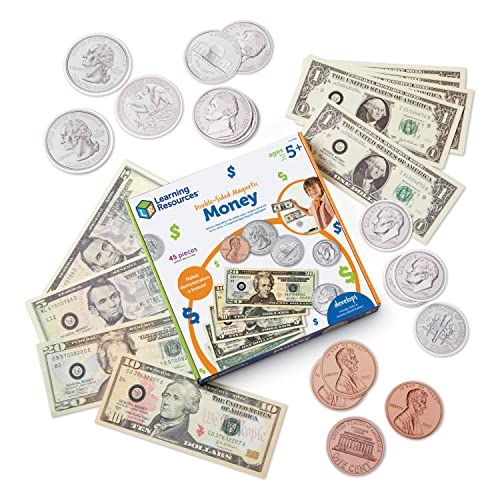
Magnetic Money Mastery for Kids
The Learning Resources Double-Sided Magnetic Money set is a delightful tool for children ages 5 and up. This vibrant 45-piece set encourages kids to identify coins and bills while developing crucial skills in counting, making change, and financial literacy through engaging, hands-on play. Perfect for home or classroom use, it not only sparks curiosity but also enhances students' mathematical understanding in a fun and interactive way.
Magnetic Money Mastery for Kids includes 45 vibrant pieces that turn learning about coins and bills into an engaging, hands-on adventure—helping kids master math while having fun!

Canadian Currency Fun for Kids
The Learning Resources Canadian Currency-X-Change invites kids to explore the world of money through play! With 211 realistic pieces, this set is perfect for developing essential sorting, counting, and money management skills while making learning engaging and hands-on. It's an excellent choice for parents and educators looking to enhance financial literacy and imaginative play in a fun, interactive way.
Canadian Currency Fun for Kids features 211 realistic pieces, making it a delightful way for kids to grasp essential money concepts while having a blast.
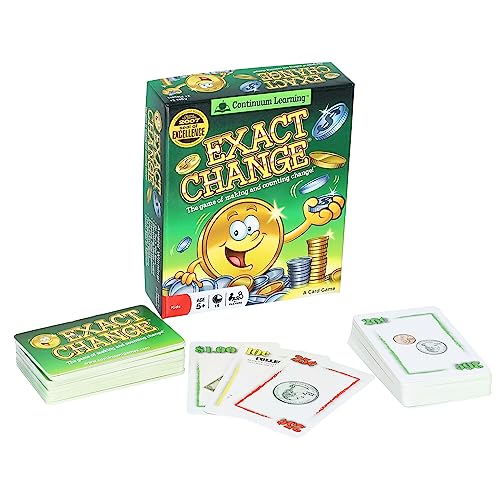
Exact Change Card Game Fun!
Exact Change Card Game is the perfect blend of fun and learning, making it an ideal choice for family game night! As parents and educators, we adore how this game teaches children valuable money-counting skills without them even realizing they're learning. With an engaging objective of playing all your cards first, kids will delight in the challenge of matching colors and making exact change, all while developing their math skills. It's a fantastic way to bond as a family while nurturing essential life skills!
Exact Change Card Game Fun! offers an exciting way to practice money-counting skills while competing to be the first to play all your cards—a perfect recipe for family bonding.

Hand2Mind Fake Money Coin Kit Fun
Hand2Mind Fake Money Coin Kit is an exciting opportunity for kids to dive into the world of money management and financial literacy! With 500 detailed and realistic plastic coins, this set not only brings pretend play to life but also supports vital learning experiences. As we engage our children in counting, sorting, and making changes, we’re helping them develop essential math skills while they play! Plus, it’s perfect for classroom settings, enriching lessons on money in a fun, hands-on way—who knew learning could be this much fun?
Hand2Mind Fake Money Coin Kit includes 500 realistic plastic coins that make mastering financial literacy feel like a game, blending fun with essential life skills.

Wooden Cash Register Fun!
The Wooden Cash Register Set by Small Foot is an imaginative gateway to creativity and learning for our little ones. With its realistic push buttons, credit card, scanner, and play money, this set transforms playtime into an exciting store experience where children can practice counting, giving change, and interacting in social play. We love how it nurtures critical thinking and fine motor skills, making number sense just as enjoyable as it is educational. Whether they’re ringing up a pretend sale or helping a ‘customer’, our kids are not just playing; they’re learning essential life skills that will last a lifetime!
Wooden Cash Register Fun! features realistic push buttons and play money, making math skills feel like an exciting game of pretend store that lays the groundwork for future financial literacy.
Educational Value
Money puzzles build what educators call numeracy in context—counting that has real purpose and meaning. When kids sort coins by value or figure out change, they're not just practicing addition and subtraction; they're developing the mental math skills they'll use for the rest of their lives, from buying lunch to managing their own finances someday.
These activities also strengthen problem-solving and critical thinking. A child examining why three coins might equal another combination of three coins is learning about equivalency and flexible thinking. Card games like Exact Change add strategy and turn-taking into the mix. And the tactile, hands-on nature of sorting real-looking coins and bills? That engages multiple learning pathways in the brain, making the lessons stick longer and feel more natural.