Best Challenging 3D Puzzles for Teens & Adults (2026)

A flat jigsaw asks you to match a picture. A 3D puzzle asks you to think in space. That extra dimension is exactly what makes these harder — and far more satisfying. Whether the challenge is steering a marble through a maze you can't see, fitting chunky pieces into a single solution, or coaxing 500 curved panels into a standing globe, the good ones reward focus and punish guessing.

We pulled together the 3D puzzles we'd actually give a sharp tween, a teen, or a puzzle-loving adult — every one from a maker with a real track record (Ravensburger, ThinkFun, Educational Insights, National Geographic), with the age, the difficulty, and a genuine reason behind each pick.

🧸 Curating learning toys since 2004 Independent picks · no pay-for-placement

Three kinds of "challenging," and which suits the gift

"Challenging 3D puzzle" covers three pretty different things, and matching the type to the person is the whole game. Some are dexterity puzzles — gravity mazes like Perplexus and the Ravensburger 3D Labyrinth, where the challenge is steering a marble through space with steady hands and nerve. Some are logic puzzles — Kanoodle, ThinkFun Gravity Maze — that set a problem with one right answer and reset for the next, so they replay forever.

And some are build-it puzzles — 3D jigsaw balls, crystal figures, architectural and wood model kits — where the difficulty is construction and patience, and the reward is a piece you display. For a restless mind that likes do-overs, pick a brain teaser. For someone who loves a long project with a keepsake at the end, pick a build. The picks below are grouped exactly that way.

Twist, tilt & roll — gravity puzzles

The toughest 3D puzzles aren't always the ones with the most pieces. These three fight you with physics: a marble you have to steer through space you can't fully see. Easy to learn, brutal to master, endlessly repeatable.

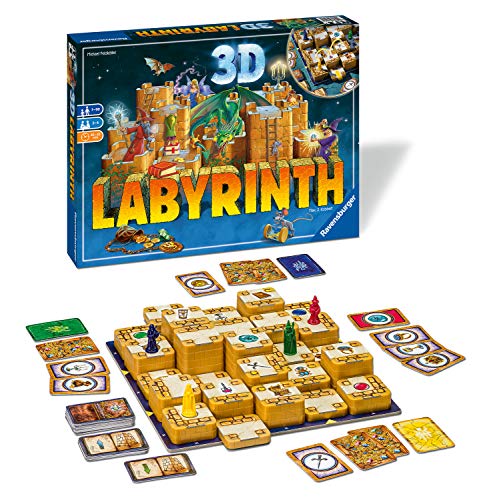
3D Labyrinth Tilting Maze Game
Best for families · Ravensburger

3D Labyrinth Tilting Maze Game

The 3D puzzle that turns a whole family into a table of furrowed brows. You tilt the layered board to roll a marble through a hidden maze you can't fully see — so every move is part memory, part nerve, part physics. It's the rare "challenging" pick that a sharp eight-year-old and a competitive grandparent enjoy at the same difficulty, because the marble doesn't care how old you are. Learns in two minutes, frustrates for years; the replay value is genuinely high since the maze can be reconfigured.

Builds: spatial reasoning · planning ahead · steady hands

~$30· See it on Amazon
Perplexus Epic Gravity Maze Ball
Best gravity maze · Spin Master

Perplexus Epic Gravity Maze Ball

One sphere, 125 numbered barriers, and a tiny steel ball you have to thread through all of them by twisting the globe in three dimensions. It is maddening in the best way — drop the ball at barrier 90 and you start over, which is exactly why people can't put it down. This is the harder big sibling to the original Perplexus, so skip it for a frustrated younger kid; for a focused 10-and-up who likes a real wall to climb, it's the standout. No batteries, no setup, endless do-overs.

Builds: fine motor · focus · frustration tolerance

~$25· See it on Amazon
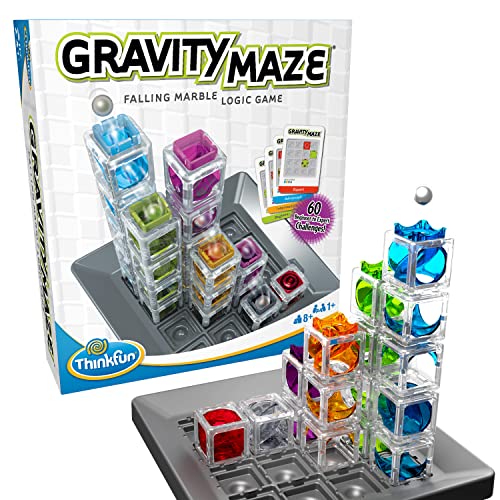
Gravity Maze Marble Logic Game
Best logic puzzle · ThinkFun

Gravity Maze Marble Logic Game

Oppenheim Gold · Parents’ Choice

The brain teaser teachers actually buy. You read a challenge card, then build a tower of clear stacked pieces so a marble dropped in the top lands in the target — but most "obvious" builds don't work, and figuring out why is the whole point. Sixty challenges climb from gentle to genuinely hard, and the later ones make adults reach for a pen. It rewards thinking before you act, which is the single best habit a logic toy can build. A modern classic for a reason.

Builds: sequential logic · spatial planning · visualization

~$20· See it on Amazon

Pocket brain teasers

Small cases, single solutions, hundreds of challenges. The puzzles you actually finish on a flight or a long car ride — and the best value in the whole guide.

Kanoodle Genius 3-D Brain Teaser
Best pocket puzzle · Educational Insights

Kanoodle Genius 3-D Brain Teaser

The best small money in this guide. A puzzle book shows you a partly-filled tray; you have to drop in the rest of the chunky 3-D pieces so everything fits with no gaps — and there's exactly one solution each time. Over 200 challenges run from "warm-up" to "I've been stuck on this for the bus ride and the walk home." It snaps shut into a case the size of a deck of cards, which makes it the travel puzzle to throw in a bag. Genuinely sized for kids, teens, and adults alike.

Builds: spatial reasoning · pattern logic · persistence

~$11· See it on Amazon
Twist Bend-and-Shape Brain Teaser
Best under $15 · Rubik’s

Twist Bend-and-Shape Brain Teaser

The pocket classic. Twenty-four triangular blocks chained together that you bend and fold into a ball, a snake, a dog, a swan — or your own shapes. Reproducing the trickier figures is a real spatial puzzle, and unlike a Rubik's Cube there's nothing to "ruin," so it's a low-stakes fidget that quietly trains the same 3D thinking. Nearly indestructible, silent, and cheap enough to toss in a backpack or stocking. A great gateway brain teaser for ages 8 and up.

Builds: spatial reasoning · sequencing · fine motor

~$13· See it on Amazon

Build-it 3D puzzles & models

Here the challenge is construction: turning a pile of curved panels, clear crystals, or laser-cut wood into something that stands on a shelf when you're done. Real weekend projects with a payoff you keep.

The Earth 540-Piece 3D Puzzle-Ball
Best display piece · Ravensburger

The Earth 540-Piece 3D Puzzle-Ball

Assembling a sphere from 540 curved plastic panels is a completely different challenge than a flat jigsaw — there's no edge to start from and gravity is working against you the whole time. The pieces are numbered on the back and click together with Ravensburger's snug Easy-Click fit, so when you finish you get a genuine globe that stands on its included base, not a thing you sweep back into a box. It's a real weekend project and an honest test of patience; the payoff is a piece you'll actually leave on a shelf.

Builds: spatial reasoning · patience · attention to detail

~$55· See it on Amazon
Eiffel Tower Night Edition 3D Puzzle
Best landmark build · Ravensburger

Eiffel Tower Night Edition 3D Puzzle

216 plastic pieces that rise into a free-standing, foot-tall Eiffel Tower — and this Night Edition adds an LED base that lights the whole thing up when it's done. Building upward is the hook: you're following a sequence and watching a recognizable structure take shape in your hands, which holds attention far better than a flat puzzle of the same piece count. Sturdy enough to keep on a desk for years. A satisfying first 3D-architecture build for a focused tween or anyone who likes models.

Builds: spatial reasoning · sequencing · patience

~$34· See it on Amazon
Empire State Building Model Kit (LED)
Best model kit · 4D Build

Empire State Building Model Kit (LED)

A proper architectural model that splits the difference between a puzzle and a build-it kit: 479 snap-together pieces, no glue, and working LED lights inside the finished skyscraper. The instructions are clear but the sheer part count makes it an evening or two of focused work — great for a teen who's graduated from kid puzzles and wants something that looks impressive on the shelf. Aimed at ages 12 and up, and it earns that rating; younger kids will lose the thread on the small pieces.

Builds: fine motor · following plans · patience

~$30· See it on Amazon
Dragon Deluxe 3D Crystal Puzzle
Best crystal puzzle · BePuzzled

Dragon Deluxe 3D Crystal Puzzle

Translucent, jewel-like plastic pieces that interlock into a standing dragon — and because every piece is clear, you can't rely on a picture, only on shape and a numbered guide. That's what makes BePuzzled's crystal puzzles deceptively hard for their piece count; people regularly get stuck near the end. This deluxe dragon is one of the more involved figures and looks genuinely striking finished. Rated 12 and up, and the small clear pieces really do need older hands and a patient temperament.

Builds: spatial reasoning · patience · trial and error

~$17· See it on Amazon
Da Vinci Catapult Wood Model Kit
Best STEM build · National Geographic

Da Vinci Catapult Wood Model Kit

Part 3D wooden puzzle, part working machine: you assemble a real, firing catapult from laser-cut wood based on da Vinci's designs — and at the end it actually launches. The build is the challenge (pieces have to seat squarely or the arm won't snap), and the reward is a STEM lesson you can fling across the room. It's our pick for the kid who likes puzzles but wants the finished thing to do something. Solidly an 8-and-up project; the construction needs steady, careful hands.

Builds: engineering basics · fine motor · cause & effect

~$30· See it on Amazon
Apollo Saturn V Rocket 3D Puzzle
Best for space fans · Ravensburger

Apollo Saturn V Rocket 3D Puzzle

A 440-piece 3D puzzle that builds into a tall, accurate replica of the Saturn V — the rocket that flew astronauts to the Moon. Like the globe, it goes together with numbered Easy-Click panels and stands on its own when finished, so it doubles as a model and a display piece. It's a meaty project that rewards a space-obsessed kid (or grown-up) with something genuinely impressive on the shelf. Rated 8 and up, but the piece count makes it a better fit for older kids and patient builders.

Builds: spatial reasoning · patience · sequencing

~$60· See it on Amazon

A note on age ratings

Take the age numbers seriously here — with 3D puzzles they're mostly about small pieces and attention span, not just safety. The Empire State model and the crystal dragon are rated 12+ because their pieces are fiddly and the builds are long; handing them to an impatient eight-year-old usually ends in a half-built kit and a meltdown. The Kanoodle, Rubik's Twist, and Gravity Maze are the friendliest entry points for a younger-but-determined kid.

How much to spend

You don't need to spend much to get a genuinely hard puzzle. The two best under-$15 picks — the Kanoodle Genius and the Rubik's Twist — deliver hundreds of challenges or endless shapes in a pocket-sized case. The $20–35 sweet spot (3D Labyrinth, Perplexus Epic, Eiffel Tower, Empire State, Da Vinci catapult) is where most generous gifts land. And the $55–60 display builds — the Earth ball and the Saturn V rocket — are weekend projects that earn a permanent spot on a shelf.

Frequently asked questions

What is the most challenging 3D puzzle for adults?
For pure difficulty, the Perplexus Epic gravity-maze ball is the wall most people hit first — 125 barriers, and one slip sends the ball back to the start. If you prefer a logic challenge over a dexterity one, ThinkFun Gravity Maze gets genuinely hard at its top levels. And among build-it puzzles, a 540-piece Ravensburger 3D ball (like The Earth) is a real test of patience because there are no edges to start from. The "hardest" depends on whether you want to out-think a puzzle or out-steady it.
Are these 3D puzzles only for adults, or are they good for kids too?
Most are family puzzles, not adults-only. The Kanoodle, Rubik’s Twist, ThinkFun Gravity Maze, and the Ravensburger 3D ball puzzles are rated roughly 8–10 and up and are great for sharp tweens through grandparents. A few — the BePuzzled crystal dragon and the 4D Build Empire State Building — are rated 12 and up because of small pieces and longer builds; those are better for teens and adults. We’ve flagged the age and the reason on every pick.
What’s the difference between a 3D jigsaw and a 3D brain teaser?
A 3D jigsaw (like the Ravensburger Eiffel Tower or Earth ball) has a fixed solution you build once into a model you can display — the challenge is construction and patience. A 3D brain teaser (Perplexus, Kanoodle, Rush-Hour-style logic games) is replayable: it sets a problem you solve with thinking or dexterity, then resets for a new challenge. Jigsaws give you a keepsake; brain teasers give you near-infinite re-plays. This guide includes both because "challenging 3D puzzle" honestly means either.
Do 3D puzzles actually build any skills, or are they just for fun?
They genuinely train spatial reasoning — the mental rotation of objects in 3D — which is one of the few cognitive skills strongly linked to STEM ability, and it improves with practice. Build-it puzzles add sequencing and patience; gravity mazes add focus and fine motor control; logic games like Gravity Maze build plan-before-you-act thinking. None of that requires a screen or a battery, which is part of the appeal. The fun is the point, but the spatial workout is real.
Which 3D puzzle is the best value?
The Educational Insights Kanoodle Genius (around $11) is the runaway value — over 200 single-solution challenges in a case the size of a deck of cards, good for kids through adults. The Rubik’s Twist (around $13) is a close second as a near-indestructible pocket brain teaser. If you want a display piece on a budget, a BePuzzled 3D crystal puzzle delivers a striking finished figure for under $20.

How we choose — and a word on the links

Educational Toys Planet has specialized in learning toys since 2004. We pick independently, only from established makers, then cross-check every candidate against current availability and the major independent award and expert lists. We don't accept payment for placement.

Affiliate disclosure: the product links here are Amazon Associate links. If you buy through them we may earn a small commission at no extra cost to you — that's what keeps these guides free and updated. Prices change; tap through for Amazon's current figure. Last updated June 2026.

Related guides