

Best Musical Hand Bells & First Instruments for Kids (2026)

Hand bells are a brilliant first instrument — one clear note per child, a melody only the whole group can play, and listening and turn-taking built right in. Dedicated kid bell sets drift in and out of stock, so we widened the net to the instruments built on the same idea: color-coded tuned tubes, a true single-note hand chime, and the xylophones that lay those same notes out in a row.

Every pick below is a real, in-tune instrument from an established maker — no random-noise gadgets — with an honest note on who it suits and where it fits a young musician's journey.

🧸 Curating learning toys since 2004 Independent picks · no pay-for-placement

What to look for in a child's first bells

The one thing that separates a real instrument from a noisy toy is whether it's actually in tune. A tuned bell, tube, or xylophone bar plays a specific, consistent note, which is what lets a child match a pitch, follow a song, and eventually reproduce a tune — the whole point of music. Color-coding is the other feature worth paying for at this age: it lets a pre-reader follow a picture song-chart and play a recognizable melody before they know a single note name.

Think about how many hands will play, too. A xylophone or a single hand chime is a solo instrument — one child, one mallet. A set of Boomwhackers or a multi-piece band is built for a group, where each child takes a note or a rhythm and they make music together. That cooperative, one-note-each format is exactly what makes traditional hand bells such a beloved classroom tool, and it's the spirit we leaned into across this guide.

Tuned bells & their cousins

Looking for hand bells specifically? These are the instruments built on the same idea — one clear, tuned note per piece — from color-coded tubes a group can play together to a true single-note hand chime.

Boomwhackers Diatonic Set of 8 (C to C)
Best tuned set · Constructive Playthings

Boomwhackers Diatonic Set of 8 (C to C)

If you came here for hand bells, this is the modern classroom answer: eight color-coded plastic tubes, each cut to a true note from C up to C, that ring out a pitch when you whack them on a knee, the floor, or a palm. Like a set of tuned bells, the whole point is that one kid holds one note and the group plays a tune together — turn-taking and listening baked right in. They're nearly indestructible, loud in the best way, and the color-coding lets a pre-reader follow a song chart before they know a single note name. A genuine music-teacher staple, not a toy that just blinks.

Builds: pitch matching · ensemble play · gross motor

~$40· See it on Amazon
Zenergy Solo Hand Chime
Closest to a real bell · Woodstock Chimes

Zenergy Solo Hand Chime

The single most bell-like thing in this guide — a precision-tuned metal chime on a wooden handle that you tap with the little striker for one clear, sustaining note. Music teachers use it as a "quiet signal," and at home it's oddly calming: kids tap it once and actually stop to listen to the tone fade, which is a real lesson in cause and effect and patience. It's a single pitch, not a melody-maker, so pair it with a tuned set above if you want to play songs — but for sheer sound quality and that pure-bell ring, nothing else here comes close.

Builds: listening · cause & effect · calm focus

~$21· See it on Amazon
Caterpillar Xylophone
Best first tuned instrument · Melissa & Doug

Caterpillar Xylophone

A xylophone is a row of hand bells laid flat — eight tuned metal bars, low to high, each a clear note when you strike it with the mallet. This one is the budget classic: cheerful, sturdy, and the perfect on-ramp for a toddler who isn't ready to manage a whole set of separate bells yet. The bars stay in tune, the mallets are sized for small hands, and a three-year-old will happily run up and down the scale discovering that bigger bar equals lower sound. Best value in the whole guide.

Builds: pitch matching · fine motor · cause & effect

~$11· See it on Amazon

Starter sets & a first band

When one instrument isn't enough, a multi-piece set lets a child (or a whole playgroup) discover the difference between shaking, striking, and ringing. These survive real use.

Make a Melody 9-Piece Wooden Instrument Set
Best starter band · B. toys

Make a Melody 9-Piece Wooden Instrument Set

When one bell isn't enough, this is the "whole band in a bag" pick: a little xylophone, a tambourine, a harmonica, and shakers, all in a drawstring storage sack so cleanup is one motion. The variety is the point — a child discovers that you shake some things, strike others, and blow into one, sorting instruments by how they make sound. Sturdier and better-finished than the dollar-store multipacks, and the bag means it actually survives more than one play session.

Builds: rhythm · sharing · experimentation

~$27· See it on Amazon
Band-in-a-Box Clap! Clang! Tap! 10-Piece Set
Best for a group · Melissa & Doug

Band-in-a-Box Clap! Clang! Tap! 10-Piece Set

Ten percussion instruments — tambourine, cymbals, maracas, a clacker, jingle bells and more — which makes it the one to buy when siblings or a playgroup all want to join in at once. It's heavy on rhythm rather than melody, so think of it as the drum-circle complement to a set of tuned bells: one group keeps the beat while another carries the tune. The pieces are real wood and metal, not flimsy plastic, and the jingle-stick in particular scratches the same itch as a handbell for the littlest player.

Builds: rhythm · turn-taking · coordination

~$19· See it on Amazon
Junior Percussion Set (3 Pieces)
Best for toddlers · Hape

Junior Percussion Set (3 Pieces)

A pared-down trio — a tambourine, a clacker, and a rattle-style shaker — that's exactly right for a one-to-three-year-old's hands and attention span. Hape's wood finishing is genuinely nice (smooth edges, non-toxic paint, the kind of thing that survives a decade of toddlers), and three instruments is enough variety without the overwhelm of a ten-piece kit. A great low-commitment way to find out whether a very young child is drawn to making sound before you invest in a bigger set.

Builds: rhythm · grip strength · listening

~$20· See it on Amazon
5-Piece Wooden Music Set
Best under $15 · Eichhorn

5-Piece Wooden Music Set

Proof you don't need to spend much to get a child started: a drum, a triangle, and maraca-eggs in solid wood, from a long-running German maker. The triangle is the sleeper hit here — like a hand chime, it gives one bright sustaining ring that kids strike again and again. It's a small set, so it works best as a stocking-stuffer or an add-on to a tuned instrument rather than a child's only music toy, but for the money it's hard to beat.

Builds: rhythm · sharing · fine motor

~$11· See it on Amazon

Solo instruments to grow into

Past the bells and shakers, these introduce breath, beat, and strings — the natural next steps for a child who's caught the music bug.

Blues Harmonica (10-Hole, Wooden)
Best pocket instrument · Hape

Blues Harmonica (10-Hole, Wooden)

A real, playable 10-hole harmonica scaled and priced for a beginner — and the rare instrument a kid can actually carry in a pocket. Where bells and xylophones are struck, the harmonica teaches that breath makes pitch too, which broadens a child's sense of how music works. It's genuinely tuned (not a noisemaker), forgiving of a beginner's technique, and the wood comb feels far nicer than the all-plastic toy versions. A great companion gift alongside a tuned bell or xylophone set.

Builds: breath control · pitch · experimentation

~$12· See it on Amazon
Double-Sided Drum
Best for rhythm · Hape

Double-Sided Drum

Every starter musician needs something to keep the beat, and a hand drum is the most intuitive instrument there is — no tuning, no wrong notes, just a satisfying thump. This wooden double-sided model comes with mallets but is just as happy played by hand, and the two heads give slightly different tones to explore. Pair it with the tuned bells or xylophone above and you've got the makings of an actual two-kid duet: one on melody, one on beat.

Builds: rhythm · coordination · gross motor

~$22· See it on Amazon
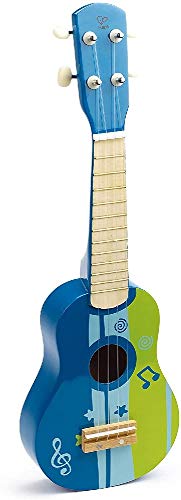
Kid's Wooden Ukulele (21 Inch)
Best step up · Hape

Kid's Wooden Ukulele (21 Inch)

For the child who's outgrown shaking and striking and wants to actually play, a ukulele is the gentlest first stringed instrument — four soft nylon strings, a small body for small arms, and it stays in tune well enough to be encouraging. It asks more patience than a bell or a drum, so it suits a slightly older or more determined kid, but it's the natural next rung on the ladder. Genuinely tunable, which matters: a uke that won't hold pitch just teaches frustration.

Builds: finger strength · pitch · persistence

~$19· See it on Amazon
Classic Xylophone Pull Toy
Best for babies · Fisher-Price

Classic Xylophone Pull Toy

The toy a lot of us remember from our own childhood, still made and still working: a tuned xylophone on wheels that plays notes as a new walker pulls it along, or sits and taps it with the mallet. It doubles as a pull-along, so it earns its keep with a child too young for a real instrument set, and the tuned bars mean the sound is musical rather than random. A sweet, durable first introduction to "I made that sound" for the under-twos.

Builds: cause & effect · pulling & walking · pitch

~$22· See it on Amazon

A quick word on "hand bells"

If you specifically want the classic eight-bell, color-coded handbell set, the closest in-stock equivalents here are the Boomwhackers tuned set (each child holds a note, the group plays the tune) and the Woodstock hand chime (a single, beautifully pure bell tone). For a solo player who wants all the notes at once, a tuned xylophone is the same eight notes laid flat. Genuine kid handbell sets do exist and occasionally come back in stock — but we'd rather point you to instruments we can actually vouch for today than pad this list with something we can't.

How much to spend

You really don't need to spend much to start a young musician. Several of the best picks here are around $11–12 — the Caterpillar Xylophone, the Eichhorn wooden set, and the Hape harmonica all over-deliver. The $19–27 range (Make a Melody, Band-in-a-Box, the double-sided drum, the ukulele) is where most generous gifts land. The one splurge worth it is the Boomwhackers set near $40 — because a whole group can play at once, the cost-per-kid is tiny.

Frequently asked questions

What exactly are musical hand bells, and is this a guide to them?
Traditional musical hand bells are a set of tuned bells — often eight, color-coded to a C-to-C scale — where each player holds one or two notes and the group rings them in turn to play a melody. They are wonderful for teaching listening and cooperation. Dedicated kid-safe bell sets come and go from stock, so this guide gathers the instruments built on the same idea: the Boomwhackers tuned set and the Woodstock hand chime are the closest direct relatives, and tuned xylophones lay the very same notes out in a row.
What is the best age to start a child on tuned bells or a first instrument?
Around 2 to 3 is the sweet spot for striking instruments like a xylophone, a hand chime, or Boomwhackers — by then a child can hold a mallet and aim it. Younger babies (under 18 months) do best with a pull-along xylophone or a simple shaker they can grip. Color-coded sets are especially good for pre-readers because a child can follow a picture song-chart long before they can read note names.
Are tuned bells and xylophones actually educational, or just noisy toys?
Genuinely educational, as long as they are really in tune. Striking a tuned bar or tube teaches pitch (bigger and longer equals lower), cause and effect, and — in a set where each child holds one note — turn-taking and ensemble listening, which is the same skill a school handbell choir builds. The key is to avoid random-noise gadgets: an instrument with true, consistent pitches lets a child match and reproduce a tune, which is where the real learning is.
Boomwhackers or a xylophone — which should I buy first?
A xylophone (like the Melissa & Doug Caterpillar) is the better solo first instrument: one child, one mallet, all eight notes in front of them. Boomwhackers shine when you have more than one player or a classroom, because each child can hold a different tube and the group plays together — much closer to the spirit of hand bells. Many families end up with both: the xylophone for everyday solo play, the Boomwhackers for group fun.
How much should I spend on a first musical instrument?
Not much at all. Several of the best picks here are around $11 to $12 — the Melissa & Doug Caterpillar Xylophone, the Eichhorn wooden set, and the Hape harmonica all punch above their price. A $19 to $27 set like B. toys Make a Melody or Melissa & Doug Band-in-a-Box makes a generous gift. The Boomwhackers set near $40 is the one splurge, and it earns it because a whole group can play at once.

How we choose — and a word on the links

Educational Toys Planet has specialized in learning toys since 2004. We pick independently, only from established makers, then cross-check every candidate against current availability and the major independent award and expert lists. We don't accept payment for placement.

Affiliate disclosure: the product links here are Amazon Associate links. If you buy through them we may earn a small commission at no extra cost to you — that's what keeps these guides free and updated. Prices change; tap through for Amazon's current figure. Last updated June 2026.

Related guides