

Best Hop Balls & Bouncing Toys for Kids (2026)

A hop ball is the rare toy that tires kids out instead of you. Sit on it, grab the handle, and bounce — and somehow that simple sphere builds real core strength, balance, and coordination while a child thinks they're just goofing around. It's the screen-free energy outlet that works indoors on a rainy day and outdoors all summer.

The classic is the 26-inch ride-on ball (the one people mean when they say "Gymnic hop ball"). Below we've picked the best of it across every age — plus pogo jumpers and balance gear for where bouncing leads next — all from makers with a real track record.

🧸 Curating learning toys since 2004 Independent picks · no pay-for-placement

How to choose a hop ball

Buying well here comes down to one thing: size. A hop ball that's too big is genuinely hard to control and gets abandoned; one that's too small is cramped and outgrown fast. The rule is to match the ball to the child's height, not just their age — when they sit on the inflated ball and hold the handle, their feet should reach the floor with knees comfortably bent. A 15–18 inch ball suits most preschoolers and early grade-schoolers; a 26-inch ball fits taller kids and lasts into the eights and nines.

After size, two things matter. Inflation: pump it firm to the printed diameter — an under-inflated ball wobbles and tips, which is where frustration (and the rare tumble) comes from. And surface: start beginners on carpet, grass, or a mat with space clear of hard furniture edges. Get those right and a hop ball is one of the safest, most durable, and most genuinely active toys you can buy.

Classic hop balls

The sit-and-bounce ride-on ball, sized for every age. Match the diameter to the child's height — knees comfortably bent when they're seated and gripping the handle — and inflate it firm.

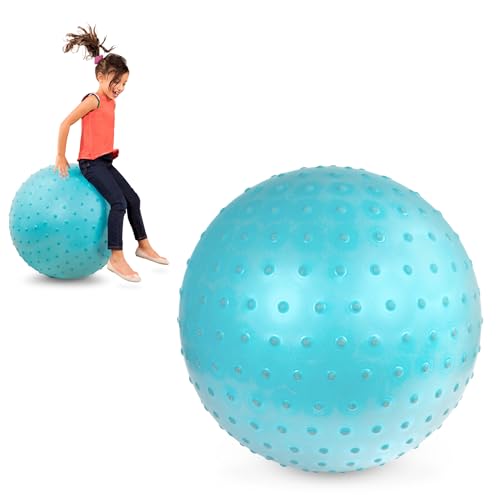
26-Inch Bouncy Hopper Ball Ride-On
Editor’s pick · B. toys

26-Inch Bouncy Hopper Ball Ride-On

This is the big-kid hop ball most people picture when they say "Gymnic ball" — a 26-inch sit-and-bounce sphere with a single ridged handle to grip and ride. It's our top pick because the size is genuinely versatile: a tall four-year-old can straddle it, and it still works for a seven- or eight-year-old, so it isn't outgrown in a season. The vinyl is thick enough to take real hopping on a carpet or lawn, and an air pump is included (you'll want to inflate it firm, not bouncy-castle squishy). One honest note: a 26-inch ball is large — inflate it to the printed size and give a beginner a soft surface, because the first few hops are all about learning to keep the handle under their center of gravity.

Builds: gross motor · balance · core strength

~$18· See it on Amazon
Hopper Ball with Handle
Best all-rounder · Flybar

Hopper Ball with Handle

Flybar has made bouncing toys for decades, and their kangaroo-style hopper is the one we'd hand a five- to nine-year-old who's ready for serious hopping. The grip handle is sturdy and sized for bigger hands, the ball holds air well, and a pump comes in the box. It's the dependable, no-frills choice: pick the size that matches the child's height (knees comfortably bent when seated) and it'll survive a summer of backyard races. Cheaper than most and hard to wear out.

Builds: balance · leg strength · coordination

~$15· See it on Amazon
Hopper Ball, 18-Inch (Monsters)
Best mid-size · Hedstrom

Hopper Ball, 18-Inch (Monsters)

If a 26-inch ball feels too big for your child, Hedstrom's 18-inch is the right step down — the classic playground hopper a lot of us remember, sized for roughly four to eight. Hedstrom has made these for years and the rubber is reliably tough. The printed monster (or flower, or character) faces give it personality kids love, and the smaller diameter means a shorter, more controllable bounce that builds confidence before sizing up. A solid first hopper for the four-to-six crowd.

Builds: gross motor · balance · active play

~$19· See it on Amazon

For the littlest bouncers

Smaller, lower, gentler — hop toys built for the 1-to-5 crowd, where the priority is a short, safe bounce and an easy grip.

My First Pogo Pals Hopper Ball
Best for little kids · Flybar

My First Pogo Pals Hopper Ball

A smaller hopper built deliberately for the three-to-five set, with a friendly animal face and a handle scaled to little hands. The lower height means a toddler's feet stay closer to the ground, so the bounce is gentle and the falls are short — exactly what you want for a first ride-on ball. It's the one we'd give a preschooler who badly wants what their big sibling has but isn't ready for a 26-inch ball yet. Pump included.

Builds: balance · core strength · confidence

~$15· See it on Amazon
B-Active My First Hopper Ball
Best first bouncer · Kidoozie

B-Active My First Hopper Ball

Kidoozie's entry hopper is aimed squarely at the 3+ beginner, and it does the job without fuss: a manageable size, an easy-grip handle, and durable inflatable vinyl that takes indoor and outdoor use. We like it as a gateway toy — the kind of thing that gets a cautious preschooler off the couch and learning to balance and bounce before they graduate to a bigger ball. Straightforward, affordable, and well-sized for small bodies.

Builds: balance · gross motor · coordination

~$20· See it on Amazon
My First Foam Pogo Jumper
Best no-fall pick · Flybar

My First Foam Pogo Jumper

Same bouncing thrill, almost no fall risk — this is a stretchy foam-and-bungee jumper a child stands on and squeezes between their feet, so it can't tip over the way a ball or pogo stick can. It even squeaks with each jump, which little kids find hilarious and keeps them at it. Rated 3+ and supports up to 250 lbs, so grown-ups can demo it too. We recommend it as the indoor companion to a hop ball: when bouncing on a big ball is too much, this is the safe version that still burns energy.

Builds: jumping · balance · rhythm

~$13· See it on Amazon
Red Rody Inflatable Bouncy Horse
Best for toddlers · GYMNIC

Red Rody Inflatable Bouncy Horse

This is the genuine GYMNIC article — the Italian-made Rody horse, the toddler cousin of the classic hop ball. A one-to-three-year-old straddles the horse, grips the ears, and bounces, building exactly the core strength and balance a hop ball does but at a height and shape that suits the very young. It's pricier because it's the real thing: thick, phthalate-free vinyl made in Italy that lasts through siblings. For the little one who isn't ready for a 26-inch ball, this is where the bouncing starts.

Builds: balance · core strength · gross motor

~$58· See it on Amazon

Where bouncing leads next

Once a hop ball is mastered, these grow the same balance and coordination skills — a pogo stick for the bold, balance gear for control.

Jolt Pogo Stick
Best next step · Flybar

Jolt Pogo Stick

When a child has mastered the hop ball and wants a real challenge, a beginner pogo stick is the natural progression. Flybar's Jolt is built for ages six and up in the 40–80 lb range, with foam grips and anti-slip pegs that make those first wobbly jumps a little more forgiving. It demands genuine balance and stick-with-it patience — the count-the-jumps game is addictive once it clicks. Buy a helmet, pick a flat surface, and expect a week of practice before the rhythm comes.

Builds: balance · coordination · persistence

~$45· See it on Amazon
River Stones Balance Set (6)
Best for balance · GONGE

River Stones Balance Set (6)

GONGE is the Danish name physical-therapy clinics and Montessori rooms actually buy, and these stepping stones are why. Kids hop and step from stone to stone, inventing their own "don't touch the floor" courses — the same balance and motor-planning workout a hop ball gives, just slower and more deliberate. The non-slip bases stay put and they stack for storage. It's the quieter half of an active-play setup: bounce to burn energy, balance to build control.

Builds: balance · coordination · motor planning

~$60· See it on Amazon
Balance Beam & Build Set
Best budget balance · B. toys

Balance Beam & Build Set

A more affordable way into balance play: interlocking beams plus textured sensory pads that a child arranges into a path, then walks heel-to-toe. At 3+ it pairs naturally with a hop ball — the ball trains the explosive, energetic side of gross motor while the beam trains the slow, controlled side. The pieces are sturdy, reconfigurable, and store flat. A genuinely good-value pick from a maker that knows toddlers.

Builds: balance · coordination · gross motor

~$30· See it on Amazon

A quick word on safety

Hop balls are low to the ground, so spills are short — but the first few sessions are a learning curve. Inflate firm, clear the space, and for the most cautious kids (or apartment floors) reach for the foam pogo jumper, which gives the bounce with almost no tip-over risk. If your child graduates to the pogo stick, add a helmet and a flat, open surface.

How much to spend

You don't need to spend much for a great hop ball. The best value sits under $20 — the B. toys 26-inch ball, the Flybar hopper, and the Hedstrom 18-inch all land here and all come with a pump. The foam pogo jumper is the cheapest way to get the bounce indoors. Spend more only for something specific: a pogo stick (~$45) for an older kid ready to level up, balance gear like GONGE River Stones, or the genuine Italian-made GYMNIC Rody horse (~$58) if you want the premium toddler version built to last through siblings.

Frequently asked questions

What size hop ball should I buy for my child?
Match the ball to height, not just age. As a rule: a 15–18 inch ball suits roughly ages 3–6, and a 26-inch ball (like the B. toys hopper here) suits taller kids from about 5 up through 8 or 9. The test is simple — when the child sits on the inflated ball and grips the handle, their feet should reach the floor and their knees should bend comfortably. Too big and they can't control it; too small and they're cramped. When in doubt, size down for a beginner.
Are hop balls and bouncy balls safe for kids?
They're safe with two precautions. First, inflate the ball firm to its printed size — an under-inflated ball is unstable and tips. Second, give beginners a soft surface (carpet, grass, a play mat) and open space away from furniture corners, because the first lessons are all about learning to keep the handle under their center of gravity. Hop balls are low to the ground, so falls are short. If you want the bounce with almost no tip-over risk, the Flybar foam pogo jumper in this guide is the safest option.
What's the difference between a Gymnic hop ball and a regular bouncy ball?
GYMNIC is an Italian brand known for thick, durable, phthalate-free vinyl — their hop balls and the Rody horse are the premium, made-in-Italy version that holds up through multiple kids. A "regular" hop ball from a brand like B. toys, Hedstrom, or Flybar does the same job (sit, grip the handle, bounce) at a lower price with perfectly good durability for most families. We included the genuine GYMNIC Rody horse for toddlers, plus several excellent value hop balls for older kids.
What skills does a hop ball actually build?
More than it looks. Bouncing on a hop ball is a full-body gross-motor workout: it builds core strength (you brace your trunk to stay upright), balance and the vestibular sense, leg power, and coordination between gripping, balancing, and timing each hop. Occupational therapists use hop balls precisely for this reason. It's also a fantastic energy-burner for high-motor kids and a screen-free way to keep moving indoors on a rainy day.
Can hop balls be used indoors?
Yes, and that's half their appeal — they're one of the best indoor energy outlets there is. Use them on a carpeted floor or a play mat, clear the area of furniture with hard edges, and make sure there's headroom (a ceiling fan is the thing to watch). On hard floors a ball can slide, so a rug or mat helps. For apartments, the foam pogo jumper bounces with less thud and travel than a full hop ball.

How we choose — and a word on the links

Educational Toys Planet has specialized in learning toys since 2004. We pick independently, only from established makers, then cross-check every candidate against current availability and the major independent award and expert lists. We don't accept payment for placement.

Affiliate disclosure: the product links here are Amazon Associate links. If you buy through them we may earn a small commission at no extra cost to you — that's what keeps these guides free and updated. Prices change; tap through for Amazon's current figure. Last updated June 2026.

Related guides