Best Toys & Gifts for Kids Learning Spanish (2026)

The best way to learn a language young is to play in it. Kids don't memorize a second language so much as soak it up — through pictures, songs, games, and the same word heard a hundred cheerful times. The right toy turns that repetition into something a child asks to do again, which beats any worksheet or app you have to nag them to open.

So we kept only Spanish toys we'd actually give a child — every one from a maker with a real track record, organized from first-words puzzles for preschoolers to a full Spanish word game for readers, with a genuine reason behind each pick.

🧸 Curating learning toys since 2004 Independent picks · no pay-for-placement

Why starting young works — and what a toy can honestly do

There's a real reason to start early, and it isn't just that small children have time on their hands. For the first years of life a child's brain is unusually good at hearing and reproducing the sounds of any language — including the ones English doesn't use, like the rolled rr or the ñ. Babies begin as universal listeners who can tell apart sounds from every language on earth, then gradually tune their ears to whatever they hear most. Early Spanish keeps that window propped open, which is why a child who plays in the language young tends to end up with the two things adult learners fight hardest for: an accurate ear, and no embarrassment about making the sounds.

It's worth being honest about the ceiling, though. A toy is not a curriculum, and no game turns a child fluent on its own. What these toys reliably build is vocabulary — a bank of words tied to real things — plus comfort, so Spanish feels normal rather than foreign, and an ear for its rhythm. Real fluency needs what a toy can't supply: lots of back-and-forth conversation and steady input over years. So treat these picks as the on-ramp, not the highway. "My preschooler can greet her abuela, name the animals and the colors, and doesn't flinch at Spanish" is a genuine, worthy win — and it's exactly the prepared ground that makes a later class, a bilingual program, or a Spanish-speaking relative take hold.

How to pick a Spanish toy that actually works

The toys that teach a language best share one trait: they tie a Spanish word to a picture and a thing, not to its English translation. That's why picture flashcards, illustrated bingo, and floor puzzles do so much heavy lifting — a child learns manzana by looking at an apple, skipping the English middleman entirely. Anything that calls the word out loud is a bonus, because it means a grown-up who doesn't speak Spanish can still run the game and learn right alongside the kids.

Match the format to the age and you can't go far wrong. Threes to fives want big, concrete, hands-on things — floor puzzles, sticker scenes, chunky letter tiles. Around six, once reading clicks, the goal shifts from naming nouns to building sentences, so verb cards, sight words, and a real word game earn their place. The single most important factor isn't the toy at all: it's how often it gets used, so pick the one your particular child will want to come back to.

Three kinds of Spanish toy — and what each is for

Look closely and almost every Spanish toy is one of three things, and they do genuinely different jobs. A good home mix is one of each rather than three of the same: a toy that makes words concrete, a deck that drills them flexibly, and a game that makes the repetition fun. Here's how the picks in this guide sort out.

Kind of toy What it actually builds Best ages Which picks here
Label-the-world (immersion play) Attaches a Spanish word to a real object or scene, so vocabulary sticks to a thing instead of to an English translation 3–6 See & Spell, the alphabet floor puzzle, Sí Sabo sticker town
Vocabulary decks (flashcards) Flexible, portable repetition you can run a dozen ways — name it, match it, quiz it in the car 2–8 eeBoo flashcards, Mudpuppy ABC ring, Verbos, the sight-word deck
Games Repetition wrapped in fun, with a spoken caller that pulls the whole family in 4–10 eeBoo Spanish Bingo, 4 Language Bingo, Spanish Scrabble

One category you'll notice we didn't lead with: battery-powered talking toys. They can model pronunciation for solo play, which is a genuine perk if no one in the house speaks Spanish — but audio quality varies wildly, the novelty tends to fade by month two, and they quietly cut the grown-up out of the loop. In these picks the spoken word comes from a person instead — the caller in a bingo round, or you reading a card aloud — which keeps a human in the practice, and that's where a language actually takes hold.

Best for first words (ages 3–5)

Early language is all about connecting a picture, a sound, and a thing. These hands-on starters keep it concrete — no screens, no translating, just play.

Spanish See & Spell Wooden Learning Toy
Editor’s pick · Melissa & Doug

Spanish See & Spell Wooden Learning Toy

The wooden toy we'd start a young learner with. Eight chunky puzzle boards each show a picture and a word in Spanish, and the child drops in the loose letter tiles to spell it — perro, gato, casa — so they're matching sound to letter to meaning all at once. It's hands-on in a way an app never is: the tiles are real wood, sized for four- and five-year-old fingers, and storing them back in the tray is half the play. Best for kids just starting out; the words stay simple and concrete, which is exactly right for a first taste.

Builds: spelling · first vocabulary · fine motor

~$20· See it on Amazon
El Spanish Alphabet Jumbo Floor Puzzle
Best for preschoolers · Sí Sabo Kids

El Spanish Alphabet Jumbo Floor Puzzle

A big, knee-level floor puzzle is how three- and four-year-olds learn best — body on the rug, hands on chunky pieces. This one walks through the Spanish alphabet (yes, including letters English doesn't have, like ñ) with bright art that gives each letter something to name. It's from a Latino-founded brand that designs specifically for bilingual households, and it doubles as a poster-sized reference once it's built. Great for a child who isn't reading yet but is ready to meet the letters.

Builds: the alphabet · letter sounds · spatial reasoning

~$25· See it on Amazon
Sí Sabo Town Bilingual Reusable Sticker Set
Best under $15 · Sí Sabo Kids

Sí Sabo Town Bilingual Reusable Sticker Set

Thirty-plus reusable stickers and two fold-out scenes turn a quiet afternoon into Spanish practice without anyone calling it practice. A kid peels la panadería, el parque, la familia onto the town and narrates what's happening — which is exactly how everyday vocabulary takes root. The stickers re-stick endlessly, so it survives more than one sitting, and it travels flat in a bag. Hard to beat for the price as a stocking stuffer or a quiet-time gift.

Builds: everyday vocabulary · storytelling · fine motor

~$13· See it on Amazon
Spanish-English ABC Ring Flashcards
Best for travel · Mudpuppy

Spanish-English ABC Ring Flashcards

Twenty-six thick cards on a reclosable ring — that ring is the whole point. They clip to a diaper bag or backpack, won't scatter across the back seat, and each double-sided card pairs a letter with a Spanish and English word and a piece of cheerful art. It skews younger (toddlers love flipping them), but it stays useful through the early-reader years as a quick alphabet-and-first-words refresher. The most portable Spanish thing on this list.

Builds: the alphabet · first words · on-the-go review

~$14· See it on Amazon

Games & flashcards that build vocabulary

Bingo and a good flashcard deck are the workhorses of a home-language routine: cheap, flexible, and endlessly replayable. They pull grown-ups and siblings into the practice, which is where words actually stick.

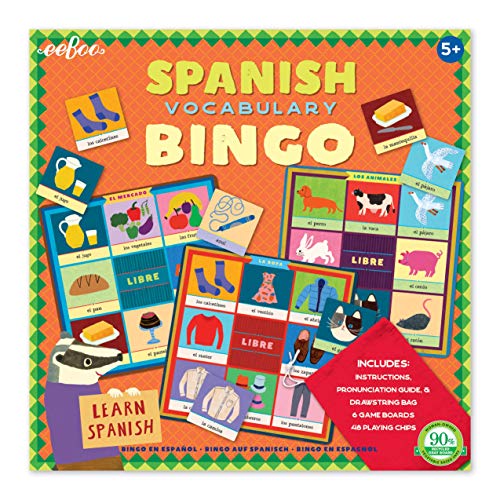
Spanish Bingo Vocabulary Game
Best game · eeBoo

Spanish Bingo Vocabulary Game

Bingo is the perfect shape for early language: you hear a word, you scan your card, you cover the match — repetition that never feels like drilling. eeBoo's illustrations are genuinely lovely (this is the brand parents quietly collect), and because the caller says the Spanish word aloud, even a non-Spanish-speaking grown-up can run a round and learn alongside the kids. It pulls in siblings and works at a family table, which is where vocabulary actually sticks.

Builds: listening vocabulary · turn-taking · recall

~$20· See it on Amazon
Spanish Vocabulary Flash Cards
Best flashcards · eeBoo

Spanish Vocabulary Flash Cards

Flash cards get a bad rap, but a good set is the cheapest, most flexible Spanish tool you can own — and eeBoo's are the good set. Big, beautifully illustrated cards pair a picture with the Spanish word, so a child connects "manzana" to an apple, not to an English crutch. Use them a dozen ways: name the picture, play memory, build a sentence, quiz on a car ride. They're the connective tissue of a home Spanish routine.

Builds: core vocabulary · pronunciation · recall

~$16· See it on Amazon
4 Language Bingo Game
Best for multiple languages · eeBoo

4 Language Bingo Game

If your house is curious about more than one language — or you just want a head start before a trip — this one covers Spanish, French, German, and Mandarin Chinese in a single bingo box. The pictures are universal, so kids match by sound and image, and you pick which language to call. It's a smart, low-commitment way to let a child hear that "dog" has a dozen names, and the same friendly eeBoo art makes it a pleasure to play.

Builds: vocabulary · listening · turn-taking

~$14· See it on Amazon

For readers & older kids (ages 6+)

Once a child is reading, the goal shifts from naming things to building sentences. Verbs, sight words, and a real word game move them from vocabulary into fluency.

Verbos — Spanish Action Words Flash Cards
Best for grammar · Trend Enterprises

Verbos — Spanish Action Words Flash Cards

Most Spanish toys teach nouns — colors, animals, food — and stop there. Verbs are where real sentences begin, and this 94-card set fills exactly that gap: each card illustrates an action (correr, comer, saltar) with the word and a sample sentence, so a child moves from naming things to saying what they do. Better suited to a six-plus reader who's ready to build phrases, and a genuinely useful complement to a vocabulary deck.

Builds: verbs · sentence building · reading

~$11· See it on Amazon
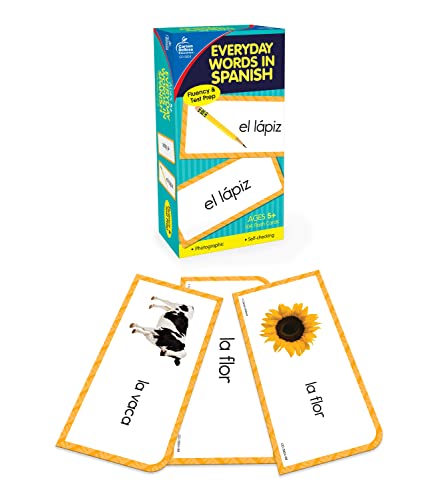
Everyday Sight Words in Spanish Flash Cards
Best for early readers · Carson Dellosa

Everyday Sight Words in Spanish Flash Cards

Sight words are the high-frequency words a reader needs to recognize instantly — and the same idea works in Spanish. This deck of 104 everyday words is built for kids learning to read in Spanish, whether they're in a dual-language classroom or a Spanish-speaking home. It's plain and practical, not flashy, which is the point: steady recognition of the words that show up on every page. A solid pick for a five-plus child moving from speaking into reading.

Builds: sight words · reading fluency · recall

~$12· See it on Amazon
Scrabble — Edición en Español
Best for older kids · Winning Moves

Scrabble — Edición en Español

For the kid (or whole family) who's past flashcards, a full Spanish-language Scrabble is the most fun a Spanish learner can have at a table. The tiles, letter values, and rules are all rebuilt for Spanish, so it actually rewards Spanish spelling rather than translating an English game. It's a real eight-and-up game — challenging, a little competitive, and the kind of thing a bilingual household keeps in rotation for years. The natural graduation gift from this guide.

Builds: spelling · vocabulary · strategy

~$22· See it on Amazon

What to reach for at each age

The same toy that delights a preschooler will bore a seven-year-old and baffle a toddler, so match the stage rather than the age printed on the box. Here's roughly where children are with a second language, and what to hand them at each point.

Age Where they are with language Reach for Not yet
1–3 · toddler All ears, few words; just learning that things have names Sturdy single-word toys — the Mudpuppy ABC ring cards are ideal to flip and name Anything with rules, small pieces, or spelling
3–5 · preschool Naming everything in sight; ready for letter sounds and short phrases See & Spell, the alphabet floor puzzle, Sí Sabo sticker town, eeBoo Bingo, picture flashcards Reading-based decks and word games like Scrabble
6–8 · early elementary Reading in one language and ready to read in another; loves to win Verbos action words, Spanish sight words, 4 Language Bingo, and Spanish Scrabble as the new anchor Little is off-limits — just keep a picture deck in rotation for fresh vocabulary

If you don't speak Spanish yourself

You don't have to — the picture-based picks here are built for exactly this situation, because they carry the word so you don't need to already know it. A few habits make the difference between a toy that teaches and one that gathers dust:

  • Weave it into routine, not a "lesson." Name three things at breakfast, count the stairs, say the colors of passing cars. Little and woven-in beats a scheduled drill a child comes to dread.
  • Let songs carry the pronunciation. A handful of Spanish children's songs plant accurate sounds and sticky phrases better than any careful adult reading — and your child will cheerfully teach them back to you.
  • Consistency beats intensity. Five minutes most days builds far more than an hour once a week. A language is a habit before it's a subject.
  • Learn out loud, alongside. When you both meet manzana on the same card, your child watches a grown-up be a happy beginner — which is quietly powerful, and you'll remember the words you say together.
  • Don't fear your accent. An imperfect grown-up accent won't undo a child who's also hearing native sounds from songs, a bingo caller, and eventually people and media. Enthusiasm matters more than a perfect rolled rr.

Screens, apps, and the case for something physical

Apps aren't the enemy — a good one models native pronunciation on demand, which a flashcard simply can't, and some children genuinely enjoy them. But for young learners we'd still make physical toys the backbone, for three reasons. The first is joint attention: two people looking at the same apple and saying manzana together is precisely the interaction that grows language, and a solo screen skips it. The second is that a puzzle has no engagement engine — it doesn't fight you at clean-up time or dangle one more level. The third is involvement: the toys here pull a sibling or a parent in, and shared play is where words stick. Our rule of thumb is to let a screen do the one thing it does best, modeling pronunciation, and let physical toys carry the daily, social, hands-on repetition. Under about age five, lean heavily physical.

Common mistakes we'd steer you around

  • Buying too advanced. Spanish Scrabble under the tree for a four-year-old is really a gift for you; it'll sit in the box until they grow into it. Match the stage.
  • Expecting the toy to do the teaching. No toy teaches a language alone — it's a prop for the repetition and play a person brings to it. The toy is the excuse; you, a sibling, or a song are the actual input.
  • Over-buying at once. One toy pulled out daily beats five in a closet. Start with a hands-on starter, a deck, and a game, and add more only once those are worn in.
  • Chasing gimmicks. A talking robot dazzles for a week and goes quiet by month two. Concrete, open-ended toys outlast novelty every time.
  • Turning play into a test. The moment it feels like drilling, a young child checks out. Keep score in the game, not in your head, and praise the trying rather than the getting-it-right.
  • Quitting too soon. Vocabulary arrives in fits and starts; a month of apparent nothing often comes right before a burst. Consistency is the whole game.

How much to spend

Learning a language is the rare gift where cheap works beautifully. Several of the best picks here are under $15 — the Sí Sabo Town sticker set, the Mudpuppy ABC ring cards, 4 Language Bingo, and the Verbos and sight-word decks all punch well above their price. The $16–25 sweet spot (See & Spell, both eeBoo games, the floor puzzle, and Spanish Scrabble) is where a generous birthday gift lands. A practical home kit is one hands-on starter, one game, and one flashcard deck — well under $50 together.

Frequently asked questions

What are the best toys for kids learning Spanish?
Start with something hands-on and concrete: our top pick is the Melissa & Doug Spanish See & Spell, which has a child spell real Spanish words with wooden tiles. Pair it with a vocabulary tool you can play many ways — eeBoo Spanish Bingo or eeBoo Spanish Vocabulary Flash Cards — and a big floor puzzle like the Sí Sabo Kids Spanish alphabet puzzle for younger learners. For a reader, add Trend Verbos action-word cards or Spanish Scrabble. Every pick here is from an established maker.
At what age should a child start learning Spanish?
As early as you like — young children pick up the sounds of a second language remarkably easily, and exposure at three or four costs nothing and pays off. For toys, match the format to the age: floor puzzles, picture flashcards, and sticker play sets suit ages 3 to 5, while sight-word decks, verb cards, and a Spanish word game like Scrabble are better for readers aged 6 and up. You do not need to speak Spanish yourself for picture-based toys — many call out the word for you.
Do these toys work if the parents don’t speak Spanish?
Yes — that is exactly what the picture-based ones are designed for. eeBoo Bingo and flashcards pair an image with the Spanish word, so you and your child learn the word together; nobody has to already know it. Floor puzzles and sticker sets work the same way, by sound and image rather than translation. The deck-and-game picks for older kids assume a bit more reading, but a beginner family can go a long way on bingo, flashcards, and a See & Spell.
Are flashcards or games better for learning a language?
You want both, and they do different jobs. Flashcards (like the eeBoo Spanish or Mudpuppy ABC sets) are the flexible core — you can name pictures, play memory, or quiz in the car, and they cost very little. Games (Spanish Bingo, 4 Language Bingo, Scrabble) supply the repetition and motivation that make vocabulary stick, and they pull the whole family in. A practical home setup is one good flashcard deck plus one game your child will ask to play again.
What’s the best Spanish gift for a child who’s already reading?
Move past naming-nouns toys toward sentences and reading. Trend Verbos action-word cards introduce the verbs that real sentences need; Carson Dellosa Spanish sight words build the high-frequency words a Spanish reader sees on every page; and Scrabble Edición en Español turns spelling into a game the whole family can play for years. Any of the three is a strong gift for a six-plus child moving from speaking into reading Spanish.
Can toys alone make my child fluent in Spanish?
Honestly, no — and any product that promises it is overselling. Toys and games are superb at three things: building a bank of vocabulary tied to real objects, making Spanish feel familiar rather than foreign, and tuning a young ear to sounds adult learners struggle with. Fluency needs what a toy can't supply on its own — lots of back-and-forth conversation and steady input over years, ideally from a person, a class, or a bilingual program. Think of these picks as the on-ramp that makes the next step land on ground that's already prepared, not the whole journey.
Will learning Spanish young slow down or confuse my child's English?
No — this is one of the most common worries, and the research is reassuring. Growing up around two languages doesn't delay either one; bilingual children hit their language milestones on a normal schedule. You may hear a child mix the two for a while, or lean on the stronger language — that's a normal passing stage, not a sign of confusion. A bingo game or a flashcard deck is nowhere near enough exposure to crowd out a child's first language, so there's really nothing to lose by starting Spanish early.
Should we use Spanish apps and screens too, or stick to physical toys?
Both have a place, but for young children we'd make physical toys the backbone. A good app does one thing a card can't — model native pronunciation on demand — so it's a fine supplement for hearing how words really sound. What screens skip is the part that actually grows language: two people looking at the same thing and naming it together. Physical toys put a grown-up or a sibling in the loop, don't fight you at clean-up time, and turn practice into shared play. Under about age five especially, lean physical and let a screen fill the single gap of pronunciation.

How we choose — and a word on the links

Educational Toys Planet has specialized in learning toys since 2004. We pick independently, only from established makers, then cross-check every candidate against current availability and the major independent award and expert lists. We don't accept payment for placement.

Affiliate disclosure: the product links here are Amazon Associate links. If you buy through them we may earn a small commission at no extra cost to you — that's what keeps these guides free and updated. Prices change; tap through for Amazon's current figure. Last updated June 2026.

Related guides