Best Learn-to-Dress Toys for Kids (2026)

"I can do it myself." Somewhere around three, a child decides they're done being dressed — and then runs straight into the buttons, zippers, buckles, snaps, and laces that stand in the way. The fastest path through that wall isn't real clothes (which fold over and hide everything); it's toys that blow each fastener up big and flat, so a child can finally see how it works and practice it slowly.

We kept only learn-to-dress toys we'd actually buy — each from a maker with a real track record, and each tied to a specific skill, from the button pinch to the shoe-tying bow. No no-name busy boards, no fluff.

🧸 Curating learning toys since 2004 Independent picks · no pay-for-placement

Why dressing is so hard — and how toys help

Getting dressed looks simple to an adult, but for a small child it's a stack of separate, demanding skills. A button is a precise thumb-and-finger pinch. A zipper is a steady two-handed pull that has to start with a fiddly little catch. Buckles and snaps take real hand strength; laces take a long sequence of crossings done in exactly the right order. Asking a four-year-old to learn all of that while the clothing twists, folds, and hides the very thing they're trying to do is what turns mornings into a meltdown.

Good learn-to-dress toys solve this by isolating each skill and scaling it up. A fastener board mounts the button flat so the child can watch it slip through the hole; a lacing sneaker uses a fat lace and big eyelets so the bow is learnable; bean bags let a kid drill one zipper a hundred times with no outfit in the way. The movements transfer directly to real clothes — and, as a bonus, the same fine-motor control sets up handwriting next year. Below, we've sorted our picks into the three things a new dresser actually needs: mastering the fasteners, learning to tie and lace, and making the whole routine feel like fun.

Master the fasteners

Buttons, zippers, buckles, snaps, and laces are the actual barrier to dressing solo. These boards and sets isolate each one — big, flat, and forgiving — so the skill clicks long before real clothes get involved.

Basic Skills Puzzle Board
Best all-in-one · Melissa & Doug

Basic Skills Puzzle Board

One board, every fastener a kid needs to master to dress themselves: a button, a zipper, a buckle, a snap, and a lace. Each one is mounted big and flat so little fingers can see exactly how it works without the fabric folding and hiding everything the way real clothes do. This is the get-dressed busy board we'd start with — it covers the most ground for the least money, and because it's a solid wooden panel rather than loose pieces, nothing gets lost under the sofa. A genuine confidence-builder for the "I can do it myself" stage.

Builds: buttoning · zipping · fine motor

~$15· See it on Amazon
Dressing Skills Bean Bags
Best for therapy use · Educational Insights

Dressing Skills Bean Bags

Five chunky bean bags, each with a different real-world fastener — a buckle, a zipper, buttons, a snap, and a lace-up shoe — so a child can drill one skill at a time without an outfit getting in the way. This is the set pediatric occupational therapists reach for, and you can see why: the bags are soft, sized for small hands, and isolate each fastener so the practice is pure. We like that they're toss-around-the-living-room durable, so dressing practice doesn't feel like a lesson. A standout for the four-and-up child still wrestling with zippers and laces.

Builds: fasteners · shoe-tying · independence

~$21· See it on Amazon
Wooden Latches Board
Best for little fingers · Melissa & Doug

Wooden Latches Board

Six little doors, six different latches — hooks, bolts, hasps — and a friendly animal hiding behind each one. The same pinch-twist-slide motions that open these latches are the ones a child needs for buttons, buckles, and snaps, so it's sneaky dressing practice dressed up as a peekaboo game. It earns a spot here because the payoff (an animal appears!) keeps kids working the fasteners far longer than a plain button board does. Solidly built, no batteries, and the kind of toy that gets handed down.

Builds: hand strength · problem solving · fine motor

~$18· See it on Amazon
Locks and Latches Board
Best for key skills · Melissa & Doug

Locks and Latches Board

A step up from the basic latch board: this one adds real working locks with keys, so alongside flipping latches a child is fitting a key, turning it, and opening a door. It's a beautiful workout for the precise pincer grip and wrist rotation that buttons and zippers demand — and the door-opening reward keeps them at it. We'd pick this one for the child who's mastered the simpler busy boards and wants a tougher challenge. Be ready to help find a "lost" key now and then; that's the only catch.

Builds: fine motor · cause & effect · persistence

~$20· See it on Amazon

Learn to tie & lace

Shoe-tying and lacing share one rhythm: feed the lace, pull it through, again and again. Practicing it oversized on wood is how the sequence finally sticks.

Deluxe Wood Lacing Sneaker
Editor’s pick · Melissa & Doug

Deluxe Wood Lacing Sneaker

The single best four-dollars-of-fun for the shoe-tying phase. It's an oversized wooden sneaker with fat eyelets and a thick lace, so a child practices the bow with everything scaled up and forgiving — no skinny shoestring, no shoe attached to a wriggling foot. Shoe-tying is genuinely hard: it's a long sequence of crossings and loops that has to happen in order, and doing it big and slow on a tabletop is how it finally clicks. Park it next to the couch and let them work the bow over and over while you read aloud. Sturdy, cheap, and it does exactly one job well.

Builds: shoe-tying · bilateral coordination · sequencing

~$11· See it on Amazon
Education Wooden Lacing Toy
Best first lacing · Battat

Education Wooden Lacing Toy

Thirty-five chunky wooden animal and shape pieces with big holes and easy laces — a gentle on-ramp to the threading motion that underlies lacing shoes and clothes. The pieces are satisfyingly thick for small hands, and because they're cute animals rather than abstract beads, toddlers actually want to string them. Lacing is where a lot of dressing skill begins: it trains the two-handed "feed and pull" rhythm before a real shoelace ever enters the picture. A sturdy, Montessori-style starter that holds up to daily handling.

Builds: threading · hand-eye coordination · pincer grasp

~$17· See it on Amazon
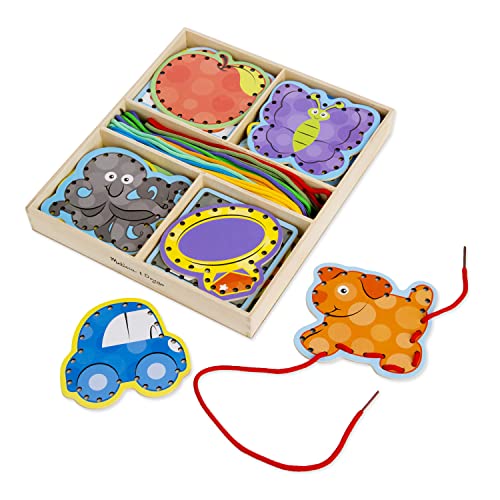
Alphabet Wooden Lacing Cards
Best lacing + letters · Melissa & Doug

Alphabet Wooden Lacing Cards

Double-sided wooden cards with punched holes around each shape, so a child laces the outline while a letter and picture do double duty as early alphabet practice. The threading is the dressing-relevant part — guiding a lace in and out of holes builds the same control and patience a shoelace will demand — and the letters mean you're not buying a one-trick toy. Pricier than a single lacing set, but you get a whole alphabet of cards and matching laces, and the wood holds up far better than cardboard punch-out versions.

Builds: lacing · letter recognition · fine motor

~$27· See it on Amazon
Lace & Trace Activity Set: Pets
Best under $15 · Melissa & Doug

Lace & Trace Activity Set: Pets

Five wooden pet panels and five colored laces — about the cheapest, most travel-friendly way to practice the threading that feeds straight into shoe-tying. Each panel is pre-punched around a cat, dog, or rabbit, and the child laces all the way around, which is a quietly demanding little task for a preschooler's hands and attention. We like it for car rides and waiting rooms: small, no pieces to lose track of, and genuinely good practice. Pair it with the lacing sneaker (pick 1) and you've covered threading and bow-tying for under $25.

Builds: lacing · hand-eye coordination · focus

~$10· See it on Amazon

Make getting dressed fun

Dressing-themed play and games do something the boards can't — they make the whole routine something a child wants to do, while sneaking in button pinches and the order clothes go on.

Abby & Emma Deluxe Magnetic Dress-Up Dolls
Best for dress-up play · Melissa & Doug

Abby & Emma Deluxe Magnetic Dress-Up Dolls

The classic magnetic wardrobe — two wooden dolls and 55-plus snap-on outfits, from rain boots to ballet tutus. It isn't a fastener trainer, but it's the toy that makes getting dressed feel fun, and that matters more than parents expect: a child who happily layers a doll's coat-over-dress-over-tights is rehearsing the order real clothes go on. The magnets are strong and the pieces are sturdy wood, not flimsy cardboard. Great for quiet independent play, and a natural pairing with the busy boards above.

Builds: imaginative play · sequencing · getting-dressed routine

~$17· See it on Amazon
Ballerina & Fairy Magnetic Dress-Up Doll
Best magnetic doll · Melissa & Doug

Ballerina & Fairy Magnetic Dress-Up Doll

A double-sided wooden doll — ballerina on one side, fairy on the other — with 52 magnetic costume pieces and a little swan companion to dress too. Same idea as the Abby & Emma set but themed for the kid who's deep in a ballet-and-fairies phase, and the extra swan gives them a second "outfit" to manage. Placing the small magnetic clothes precisely is good pinch-and-place practice, and the open-ended dress-up fuels long stretches of storytelling. Travels well, since the pieces cling to the board.

Builds: imaginative play · fine motor · storytelling

~$18· See it on Amazon
Pete the Cat I Love My Buttons Game
Best button game · Educational Insights

Pete the Cat I Love My Buttons Game

A board game built entirely around the one skill that frustrates new dressers most: buttons. Kids race to button colorful discs onto Pete's coat, which is the exact thumb-and-finger pinch a real shirt button needs — just bigger, slower, and wrapped in a game everyone wants to play. It pulls double duty as fine-motor practice and a first turn-taking game, and the Pete the Cat tie-in earns instant buy-in from preschool fans. A clever way to get reluctant buttoners to practice without it feeling like practice.

Builds: buttoning · color matching · turn-taking

~$16· See it on Amazon

A practical way to use these

You don't need all eleven. A complete kit for under $35 is one all-in-one fastener board (Basic Skills Puzzle Board), the lacing sneaker for shoe-tying, and a magnetic dress-up doll to keep it fun. Keep the board by the couch and let your child work it during read-aloud or a show — short, low-pressure sessions beat a formal "lesson" every time, and the skill quietly shows up in real getting-dressed a few weeks later.

How much to spend

These are mercifully cheap. Several of the best are under $15 — the lacing sneaker, the Basic Skills board, and the Lace & Trace pets all punch well above their price. The $16–21 range (the dressing bean bags, latch boards, the Pete the Cat buttons game, and the dress-up dolls) is where the most generous single gifts land. Only the Alphabet Lacing Cards climb past $25, and that's because you're getting a whole alphabet of cards — not just one dressing skill.

Frequently asked questions

What toys help a child learn to dress themselves?
The most useful are fastener boards and dressing sets that isolate one skill at a time — buttons, zippers, buckles, snaps, and laces — mounted big and flat so a child can see exactly how each works without the fabric folding over. Our top pick for covering the most ground is the Melissa & Doug Basic Skills Puzzle Board, which has all five fasteners on one panel. The Educational Insights Dressing Skills Bean Bags do the same in a soft, toss-around format favored by occupational therapists. Add a lacing sneaker for shoe-tying and a magnetic dress-up doll to make the routine fun.
At what age should a child learn to dress and tie shoes?
Most children start managing simple clothes — pulling on pants, big snaps, large buttons — around ages 3 to 4, which is when fastener boards and dressing dolls land best. Zippers and small buttons usually come together around 4 to 5. Shoe-tying is the last and hardest step: it is a long sequence of crossings and loops that most kids do not reliably master until 5 to 7. There is wide normal variation, so follow your child rather than the calendar — and practicing oversized on a wooden lacing sneaker makes the bow far easier to learn than fumbling with a real shoe.
How do dressing boards and busy boards build fine motor skills?
Every fastener on a dressing board trains a specific hand movement that real clothes require: buttons build the thumb-and-finger pinch, zippers build a controlled pull, buckles and snaps build hand strength, and latches build the wrist rotation a key or a clasp needs. Doing these motions slowly and in the open — instead of hidden inside a wriggling outfit — lets a child build the muscle memory first. Those same muscles and movements also set up handwriting, which is why preschool teachers and occupational therapists lean on these toys so heavily.
Are dress-up dolls useful for teaching dressing, or just for play?
Both, in a quiet way. A magnetic dress-up doll like the Melissa & Doug Abby & Emma set will not teach a child to work a real button, but it does two genuinely useful things: it rehearses the order clothes go on — tights before the dress, coat over the top — and it makes the whole idea of getting dressed feel like fun rather than a battle. Placing the small magnetic pieces precisely is also decent pinch-and-place practice. Think of dress-up dolls as the motivation half and the fastener boards as the skills half; they work well side by side.
Which brands make the best learn-to-dress toys?
For dressing and fine-motor skills specifically, Melissa & Doug is the deepest bench — the lacing sneaker, Basic Skills board, latch boards, lacing cards, and magnetic dress-up dolls are all theirs and all well made in solid wood. Educational Insights makes two standouts here: the Dressing Skills Bean Bags and the Pete the Cat buttons game. Battat and Bigjigs make sturdy Montessori-style lacing toys for the youngest learners. Every toy in this guide comes from one of those established makers — no random no-name busy boards.

How we choose — and a word on the links

Educational Toys Planet has specialized in learning toys since 2004. We pick independently, only from established makers, then cross-check every candidate against current availability and the major independent award and expert lists. We don't accept payment for placement.

Affiliate disclosure: the product links here are Amazon Associate links. If you buy through them we may earn a small commission at no extra cost to you — that's what keeps these guides free and updated. Prices change; tap through for Amazon's current figure. Last updated June 2026.

Related guides