

Best Saxophone & Musical Play Toys for Kids (2026)

Every kid is a musician before they can talk. They bang the pot, shake the rattle, hum in the car. A light-up saxophone or a tiny ukulele simply gives that instinct a shape — and the best musical toys do it without becoming blinking plastic that plays for the child. The trick is matching the instrument to the age: instant press-and-hear sound for toddlers, real keys and strings for the kid ready to go deeper.

So we kept only instruments we'd actually hand a child — every one from a maker with a real track record (LeapFrog, Hape, Melissa & Doug, B. toys), with an honest note on what each one really is, who it's for, and how loud it gets.

🧸 Curating learning toys since 2004 Independent picks · no pay-for-placement

Toy or real instrument? Match it to the age

The most common mix-up with musical toys is expecting too much, too soon. The famous jazzy saxophone is an electronic toddler toy — chunky buttons, lights, and songs — and it's perfect for a one- or two-year-old who just needs a sound to follow a press. It is not a path to actually playing sax, and that's okay: the job at that age is the cause-and-effect loop, not technique.

Around three and up, kids can handle real instruments in miniature — a harmonica they blow, a tuned xylophone they strike, a ukulele they strum, a keyboard they pick out a melody on. These reward a little practice and quietly teach pitch and rhythm. By five or six, a small tunable guitar becomes a genuine starter instrument. The guide below is grouped exactly that way — winds first, then keys and strings, then band sets, then first instruments for the littlest hands.

Horns, whistles & the groovy sax

The wind family is where this guide starts — from the light-up jazzy saxophone that probably sent you here to a real harmonica a child blows with their own breath.

Learn & Groove Jazzy Saxophone
The groovy saxophone · LeapFrog

Learn & Groove Jazzy Saxophone

The toy that probably brought you to this page — and it's a genuinely good first "instrument" for a toddler. There are no real reeds to fight with: a chunky button under each painted key plays a sax note, a color, or a number, so an 18-month-old gets instant sound for almost no coordination. There are play modes that string the notes into little jazz songs the child can "play along" with. It is, to be clear, an electronic light-up toy and not a path to actual saxophone — but for ages 1.5 to 3 it nails the thing that matters most: press, hear, delight, repeat. Takes batteries; it does sing on its own, so an off switch in your pocket helps.

Builds: cause & effect · color & number names · rhythm

~$22· See it on Amazon
Blues Harmonica
Best real wind · Hape

Blues Harmonica

If the saxophone toy sparks a love of horns, a harmonica is the cheapest way to give a preschooler a real wind instrument — one where their own breath, in and out, actually makes the note. This is a proper 10-hole wooden harmonica scaled for small hands, not an electronic fake. Three-and-ups figure out the in-out, loud-soft logic fast, and it sneaks in genuine breath control. Fair warning to grown-ups: it is loud and unfiltered, which is exactly why kids adore it.

Builds: breath control · cause & effect · listening

~$12· See it on Amazon

Keys & strings to grow into

When a child wants to go deeper than press-and-hear, these are real-feeling instruments — tuned keys and actual strings — that reward a little practice.

Learn-to-Play Piano with 25 Keys
Best keyboard · Melissa & Doug

Learn-to-Play Piano with 25 Keys

A keyboard is where a musically curious kid goes deeper, and this wooden one is built to last with 25 real keys and a color-coded songbook. Because each key plays a fixed, tuned note (not a sampled jingle), a four-year-old can actually pick out a melody and start to hear that higher and lower live in different places — the first step toward real music-reading. It's solid, non-electronic, and the kind of toy that survives a younger sibling. The color-dot songs make "Twinkle, Twinkle" achievable on day one.

Builds: pitch awareness · reading readiness · fine motor

~$30· See it on Amazon
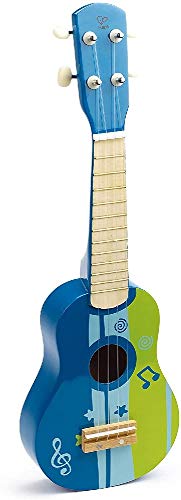
Kid's Wooden Ukulele, 21 inch
Best first strings · Hape

Kid's Wooden Ukulele, 21 inch

The friendliest entry into stringed instruments. A ukulele is small, light, and forgiving in a way a guitar isn't, and this 21-inch wooden one has four real, tunable nylon strings — so a three-year-old strums and immediately hears chords ring out. It's a toy in size but an instrument in spirit: kids learn that strumming makes rhythm and pressing changes the sound. You will need to tune it (a clip-on tuner helps), and it stays in tune better than the bargain-bin plastic versions.

Builds: fine motor · rhythm · patience

~$19· See it on Amazon
26-Inch Kids Guitar, 4 Tunable Strings
Best for older kids · Hape

26-Inch Kids Guitar, 4 Tunable Strings

For the five- or six-year-old who's serious about wanting "a real guitar," this is the honest middle step — a 26-inch wooden instrument with four tunable strings, big enough to feel legit but sized for a child. It actually holds a tune and produces a warm sound, so practice is rewarding instead of tinny. It's the priciest pick here for good reason: it's closer to a starter instrument than a toy, and it'll outlast the phase. Younger kids can strum it on a lap; older ones can start learning chord shapes.

Builds: fine motor · coordination · persistence

~$45· See it on Amazon

Whole-band sets & rhythm makers

Music is most fun shared. These sets and percussion toys get a roomful of kids each holding something, learning steady beat by playing it.

Band-in-a-Box Clap! Clang! Tap! 10-Piece Set
Best variety · Melissa & Doug

Band-in-a-Box Clap! Clang! Tap! 10-Piece Set

The single best value for sparking music play, because it's ten instruments in one box — tambourine, cymbals, maracas, clacker, and more — so a roomful of kids can each grab something and form an instant band. That variety is the point: a child discovers which sound they love by trying them all, and the percussion teaches steady beat far better than any screen. It comes with a sturdy carry crate, which is the difference between "fun set" and "pieces lost under the couch by Tuesday." Wonderful for siblings and playdates.

Builds: rhythm · sharing & turns · gross motor

~$19· See it on Amazon
Make a Melody 9-Piece Wooden Instruments
Best wooden set · B. toys

Make a Melody 9-Piece Wooden Instruments

If you'd rather skip plastic, this nine-piece wooden set is the warm-toned alternative — a little xylophone, tambourine, harmonica, and assorted shakers and clappers that all sound nicer than their electronic cousins. The natural materials and a drawstring storage bag make it a tidy, giftable bundle for a two-year-old who's ready for "real" instruments in miniature. Wood means it's quieter and more pleasant for grown-up ears, too, while still giving a toddler that essential press/shake/strike-and-hear loop.

Builds: rhythm · fine motor · listening

~$27· See it on Amazon
Mighty Echo Microphone (Battery-Free)
Best for singers · Hape

Mighty Echo Microphone (Battery-Free)

Music isn't only instruments — for a lot of kids the first instrument is their own voice, and this microphone is pure clever design. It has no batteries and no electronics: it amplifies and echoes a child's voice acoustically, just by the shape of the tube. So a shy toddler hears themselves boom and giggle, and it never breaks, never needs charging, and makes zero electronic noise. It's a tiny confidence machine for singing, counting, and storytelling, and at around eleven dollars it's the easiest yes on this list.

Builds: language · confidence · breath & voice

~$11· See it on Amazon

First instruments for the littlest

For toddlers, the magic is simply "I made a sound." These tuned, sturdy toys nail that loop without frustration.

Caterpillar Xylophone with Wooden Mallets
Best under $15 · Melissa & Doug

Caterpillar Xylophone with Wooden Mallets

A xylophone is the perfect bridge between banging and music: the rainbow bars are tuned, so a three-year-old striking them in order actually plays a scale and hears notes climb. This cheerful caterpillar version comes with two wooden mallets and is sized and priced as a no-brainer first-melody toy. Hitting a specific bar to make a specific note is real hand-eye coordination, and the in-tune bars mean it sounds pleasant rather than like a clatter — which keeps both kid and parent coming back.

Builds: pitch awareness · hand-eye coordination · cause & effect

~$11· See it on Amazon
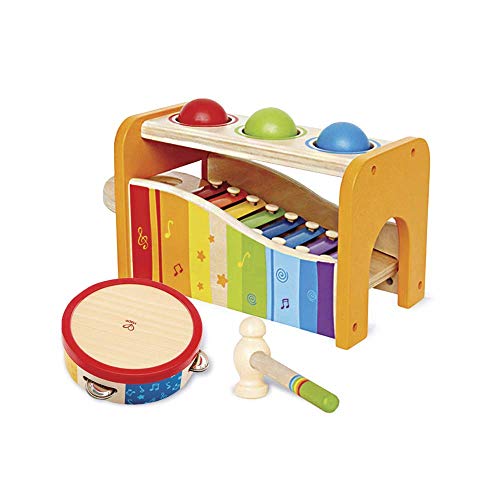
Pound, Tap & Shake! Music Set
Best for toddlers · Hape

Pound, Tap & Shake! Music Set

Award-winning wooden design

For the youngest musicians — roughly one to four — this combines three classic developmental toys: a pound bench (hammer the balls, they fall and ping the xylophone), a slide-out baby xylophone, and a tap-along tambourine. It's the toy that teaches "I do a thing and a sound happens," which is the entire foundation of music play, while building serious hand strength. Non-toxic wood in the Montessori vein, and the three-in-one design means it grows with the child from first whacks at one to deliberate little tunes at three.

Builds: hand strength · cause & effect · rhythm

~$36· See it on Amazon

A word on batteries & volume

Two practical notes before you buy. First, the electronic toys (the Jazzy Saxophone) need batteries and play sound on their own — make sure yours has an accessible off switch, and keep spare AAs handy. Second, all of these are loud, because loud is the whole point for a kid. The wooden and acoustic picks (the harmonica, xylophone, and wooden set) tend to sound more pleasant to adult ears than buzzy electronics — and the battery-free Hape microphone is gentler than you'd expect.

How much to spend

You don't need to spend much to spark a love of music. Several of the best picks here are under $15 — the microphone, the caterpillar xylophone, and the harmonica all punch above their price. The $19–36 sweet spot (the saxophone, 25-key piano, Band-in-a-Box set, and Pound, Tap & Shake bench) is where most generous gifts land. The one splurge worth it is the 26-inch Hape guitar — closer to a real starter instrument than a toy, for the older kid who's ready.

Frequently asked questions

Is the LeapFrog Jazzy Saxophone a real saxophone?
No — and that is fine for its age. It is an electronic, light-up toy for toddlers (about 18 months to 3 years): pressing a chunky button under each key plays a sax note, a color name, or a number, with modes that build the notes into little jazz songs. There are no reeds and no breath involved, so a very young child gets instant success. If your child is older and wants to actually play a wind instrument with their own breath, start with the Hape Blues Harmonica instead, then a recorder around school age.
What is a good first musical instrument for a toddler?
For ages roughly 1 to 3, pick something that makes a satisfying sound for almost no skill: the LeapFrog Jazzy Saxophone, a Melissa & Doug or B. toys percussion set, a caterpillar xylophone, or the Hape Pound, Tap & Shake bench. The goal at this age is the cause-and-effect loop — "I press or strike, and a sound happens" — not real technique. Tuned toys (xylophones, real keyboards) are worth choosing over random-noise ones because they sound pleasant and quietly teach pitch.
At what age can a child start learning a real instrument?
Most kids are ready for a genuine starter instrument around 4 to 6. A real-keyed keyboard (like the Melissa & Doug 25-key piano) or a ukulele works well from about 3 to 4 because they are forgiving; a small tunable guitar suits 5 and up. Before that, the toy instruments in this guide build the rhythm, listening, and fine-motor foundations that make formal lessons easier later. There is no rush — early music play is about joy and steady beat, not performance.
Are wooden instruments better than plastic electronic ones?
They are different, not strictly better. Wooden instruments (Hape, B. toys, the M&D xylophone and piano) usually sound more pleasant, have no batteries, make no electronic noise, and last for years — many parents prefer them. Electronic toys like the Jazzy Saxophone offer lights, songs, and instant feedback that some toddlers find more captivating, and modes that teach colors and numbers. A good middle path: one tuned wooden instrument plus one light-up toy covers both kinds of play.
How do I deal with how loud musical toys are?
Loudness is part of the appeal, so manage it rather than fight it. Battery toys like the saxophone have an off switch and often a volume setting — use both. Acoustic toys (harmonica, xylophone, tambourine) cannot be turned down, but they tend to sound nicer than buzzy electronics, and you can set "indoor voice" rules for instruments just like for kids. Wooden sets are generally gentler on adult ears than light-up plastic. And the battery-free Hape microphone amplifies less harshly than you would expect.

How we choose — and a word on the links

Educational Toys Planet has specialized in learning toys since 2004. We pick independently, only from established makers, then cross-check every candidate against current availability and the major independent award and expert lists. We don't accept payment for placement.

Affiliate disclosure: the product links here are Amazon Associate links. If you buy through them we may earn a small commission at no extra cost to you — that's what keeps these guides free and updated. Prices change; tap through for Amazon's current figure. Last updated June 2026.

Related guides