

Best Quiz & Trivia Games for Kids (2026)

Every kid wants to host the quiz. The appeal of a "build your own quiz game" isn't really the questions — it's standing in front of the family, working the buzzer, and declaring who got it right. The good news: you don't need an app or a single branded product to make that happen. A set of game-show buzzers plus a deck of questions turns any evening into a proper quiz night, and the pieces are cheap.

So we built this guide around the real toolkit — buzzers, ready-made buzz-in games, and question decks you can remix — every one from a maker with a track record, with an honest reason behind each pick and a note on the age it actually suits.

🧸 Curating learning toys since 2004 Independent picks · no pay-for-placement

How to build a quiz game that kids actually replay

A home quiz game has three moving parts, and you can buy or improvise each one. First, the questions — a trivia deck, a themed card set, or a list you and your child write together. Second, the buzz-in — a set of buzzers is what separates a quiet quiz from a loud, competitive one, and it's the upgrade kids beg for. Third, the format: whether you study a picture and then answer (BrainBox), race to buzz (Riddle Moo This), or pit kids against grown-ups with age-fair questions (Beat the Parents).

The format matters more than the trivia. The games that get replayed are the ones where a younger or less-bookish child still has a real chance to win — through observation, lucky guesses, picture recognition, or a handicap built into the rules. Lead with one of those, add buzzers, and let the kids take turns being the quizmaster. Reading the questions aloud is half the learning, and most of the fun.

Build your own quiz show

Start here if the goal is a noisy, competitive, make-your-own quiz night. A set of buzzers plus a question deck is all you need — the buzzers turn any facts into a game-show round.

Answer Buzzers, Set of 4
Editor’s pick · Learning Resources

Answer Buzzers, Set of 4

If you want to "build your own quiz game" at home, this is the single thing that makes it feel real. Four chunky buzzers, four distinct game-show sounds — and suddenly any stack of questions you make up, or pull from a trivia deck, becomes a proper contest with a "first to buzz" rule. They need no app and no batteries-included drama; you press, they sound, kids go wild. We put it first because it's the cheapest way to turn a quiet trivia card game into a loud, competitive one, and it pairs with literally every other pick on this list.

Builds: turn-taking · quick recall · listening

~$16· See it on Amazon
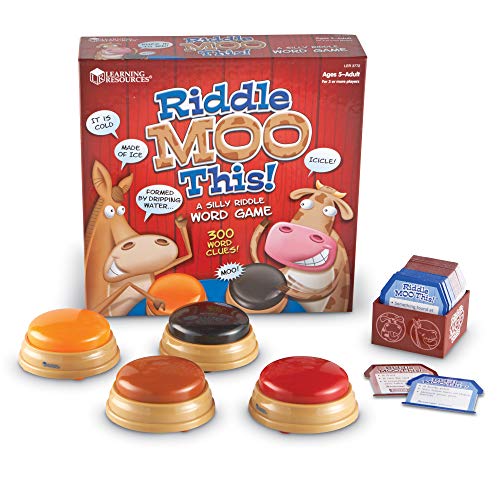
Riddle Moo This Word Game
Best buzz-in game · Learning Resources

Riddle Moo This Word Game

This is the closest thing to a ready-made buzz-in quiz show in a box: 150 riddle cards and four cow-shaped buzzers, so the question-asking and the racing-to-answer are both built in. A reader poses the silly riddle, everyone listens, and the first to buzz gets the guess. It works well for mixed ages because the riddles reward sideways thinking rather than memorized facts, so a sharp six-year-old can genuinely out-buzz an adult. One honest note: it needs a confident reader to run the round, so it's a family or classroom game more than a kids-alone one.

Builds: vocabulary · lateral thinking · turn-taking

~$29· See it on Amazon
Brain Teasers Trivia Card Game
Best general quiz · Ridley’s

Brain Teasers Trivia Card Game

A no-board, no-setup deck of 140 general-knowledge questions you can deal out anywhere — the kitchen table, the back seat, the waiting room. It's pitched at "kids and adults," which in practice means the questions are mixed in difficulty, so it's perfect raw material if you want to assemble your own quiz rounds and run them with the buzzers. Cheap, pocketable, and endlessly re-playable because nobody remembers 140 answers. The card stock is fine, not heirloom-grade, but at this price that's an easy trade.

Builds: general knowledge · recall · turn-taking

~$12· See it on Amazon

Kids vs. grown-ups

The single best trick for hooking children on trivia: give them a fair shot at beating the adults. These two do exactly that, with age-balanced questions.

Beat the Parents Classic Family Trivia
Best kids-vs-grown-ups · Spin Master

Beat the Parents Classic Family Trivia

The clever twist here is that the kids get kid questions and the grown-ups get adult questions, so a seven-year-old can legitimately beat Mom and Dad — and that even playing field is exactly what keeps children coming back to a quiz game. It's a board-and-cards format, so a round takes a bit longer than a card deck, but the head-to-head framing turns trivia into a rivalry kids actually request. Best with an even mix of kids and adults; less fun if it's all one age group.

Builds: general knowledge · confidence · family play

~$20· See it on Amazon
Bluey Beat the Parents
Best for ages 5–7 · Spin Master

Bluey Beat the Parents

The same kids-versus-parents idea, scaled down for the Bluey crowd. Rounds are short, the questions are simpler, and there are little up-and-active challenges mixed in so wiggly five- and six-year-olds don't have to sit still the whole time. If your child is too young for a straight trivia deck but loves the idea of quizzing the grown-ups, this is the gentler on-ramp — and the Bluey hook does a lot of work getting reluctant players to the table.

Builds: early general knowledge · gross motor · family play

~$15· See it on Amazon

Quizzes that teach

Question games that quietly reinforce real school skills — observation, memory, mental math, and science vocabulary — without ever feeling like homework.

BrainBox: The World
Best solo-friendly quiz · BrainBox

BrainBox: The World

BrainBox flips the usual quiz format in a way kids love: you study one richly illustrated card for ten seconds, then flip it and answer a question about what you just saw. It's memory and observation as much as knowledge, which means even a child who "doesn't know geography" can win by looking hard. It plays solo or in a group, the rounds are genuinely ten minutes, and the World edition sneaks in a surprising amount of real-place learning. A fantastic format to study before you design your own "look, then quiz" rounds at home.

Builds: observation · memory · geography

~$17· See it on Amazon
BrainBox: Maths
Best for math practice · BrainBox

BrainBox: Maths

The same beat-the-timer, observe-then-answer engine as the World edition, pointed at numbers — shapes, sequences, simple operations, and the kind of "how many were there?" questions that make mental math feel like a game instead of a worksheet. It's our pick for the household that wants the quiz night to quietly reinforce school skills. Same caveat as the World set: it's strongest from about eight up, when reading the cards independently stops being a bottleneck.

Builds: mental math · observation · memory

~$16· See it on Amazon
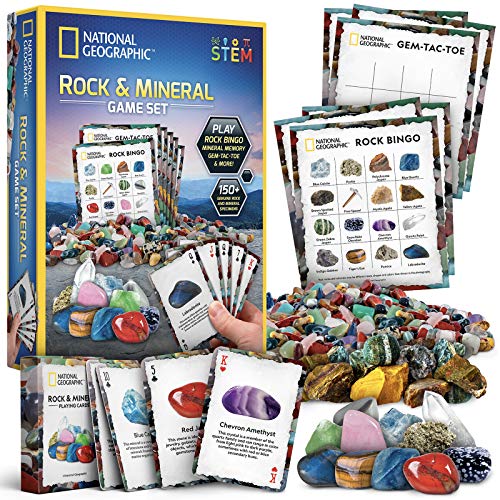
Rock Bingo Game
Best STEM quiz · National Geographic

Rock Bingo Game

A bingo-and-trivia hybrid built around 150 real rocks and minerals — so the "quiz" comes with actual specimens kids can hold, match, and ask each other about. It's the pick for a STEM-leaning household: the gemstone trivia and mineral-memory modes turn identification into a game, and the physical rocks give the questions weight that a flat card can't. Pricier than the card decks here, but you're partly paying for the rock collection, which kids tend to keep long after the game itself.

Builds: science vocabulary · matching · observation

~$25· See it on Amazon

Themed & picture decks

For younger players, pre-readers, and the one-topic-obsessed: themed and image-based quizzes that meet a child exactly where their interest already is.

Dinosaurs Trivia Quiz Cards
Best themed deck · Petit Collage

Dinosaurs Trivia Quiz Cards

Fifty dinosaur question cards — the easiest possible win for the dino-obsessed five-to-eight-year-old who already knows more than you do. Themed decks like this are the secret to getting a quiz-resistant kid hooked: when the topic is the thing they love, they'll happily sit through round after round. The illustrations are lovely (Petit Collage's whole thing), and it's small enough to live in a bag. Narrow by design, which is the point — pick the deck that matches your child's current obsession.

Builds: focused knowledge · recall · reading

~$12· See it on Amazon
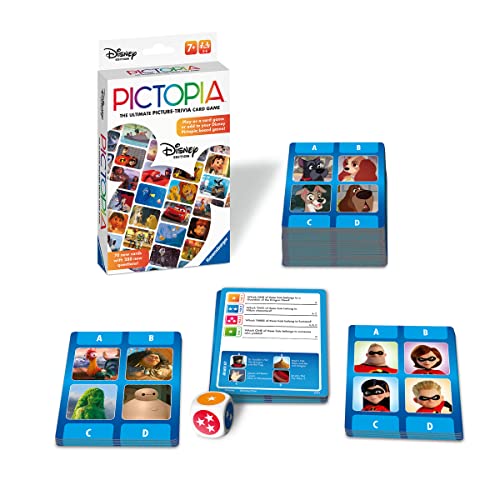
World of Disney Pictopia Card Game
Best picture trivia · Ravensburger

World of Disney Pictopia Card Game

Picture-based trivia is a smart leveler for families with pre-readers or early readers: a lot of the questions hang off images, so a four- or five-year-old who can't read a fact card can still recognize a Disney character and shout the answer. It's travel-sized, it's cheap, and the Disney hook means buy-in is instant. Don't expect deep general knowledge — it's a fan-trivia game — but for a young, mixed-age table it earns its small footprint.

Builds: recall · family play · turn-taking

~$10· See it on Amazon
Guess Who? The Original Guessing Game
Best question-asking game · Hasbro Gaming

Guess Who? The Original Guessing Game

Worth including because it teaches the other half of a quiz: how to ask a good question. The whole game is narrowing down a hidden character with sharp yes/no questions ("Do they wear glasses?"), which is genuine deductive reasoning dressed up as a duel. It's two-player, fast, and the flip-down frames are deeply satisfying. We'd hand this to any six-year-old who's starting to enjoy "twenty questions" — it sharpens exactly the skill that makes them a better quizmaster later.

Builds: deductive reasoning · yes/no questioning · strategy

~$17· See it on Amazon

The cheapest way to start

You can have a real quiz night for under $30. Grab the Answer Buzzers (~$16) and one question deck like Ridley’s Brain Teasers (~$12), and you're done — write a few of your own questions, deal the deck, and run rounds until bedtime. The buzzers are the part worth spending on; the questions can come from anywhere, including a notebook your child fills in themselves.

How much to spend

Most of these are $10–17 — the Disney Pictopia deck, the Dinosaurs trivia cards, both BrainBox sets, and the Brain Teasers deck all land there and travel well. The $20–29 tier (Riddle Moo This, Beat the Parents, Nat Geo Rock Bingo) buys a more complete, out-of-the-box experience — buzzers included or a whole rock collection thrown in. There's no single splurge here; the smartest spend is a set of buzzers plus two cheap decks.

Frequently asked questions

What is the best "build your own quiz" game for kids?
For a true make-your-own quiz, start with Learning Resources Answer Buzzers — four game-show buzzers that turn any set of questions you write (or any trivia deck) into a buzz-in contest. Pair them with a general-knowledge deck like Ridley’s Brain Teasers, and you can run unlimited custom quiz rounds at home with no app and no setup. Riddle Moo This is the closest thing to a ready-made buzz-in quiz show in a single box.
What age are quiz and trivia games good for?
It depends on the format. Buzzer games and picture-trivia like Disney Pictopia work from about age 5, because a non-reader can still recognize images and race to buzz. Card-reading trivia (Ridley’s Brain Teasers, the BrainBox sets) is strongest from about age 8, when kids can read the cards independently. For ages 5 to 7 specifically, Bluey Beat the Parents and themed decks like the Petit Collage Dinosaurs cards are the gentlest on-ramps.
How do I make a trivia game fun for mixed ages?
Two reliable tricks. First, use a format that levels the field: "beat the parents" games give kids easier questions than adults, and observation games like BrainBox reward looking carefully rather than knowing facts. Second, add buzzers — racing to buzz keeps younger players engaged even on questions they might not win, and it turns a quiet card game into an event the whole family asks to replay.
Do quiz games actually help kids learn?
The good ones do, because recall under a little friendly pressure is genuinely how memory sticks — it is the same "retrieval practice" teachers use. Beyond facts, these games build skills you would not expect: Guess Who? trains deductive yes/no questioning, BrainBox trains observation and memory, and running your own quiz rounds builds reading and confidence. The key is to favor games where the child is doing the thinking, not just watching a screen quiz them.
What do I need to host a family quiz night?
Surprisingly little. A set of buzzers (about $16), one or two question decks, and a willing quizmaster to read the rounds. Mix a general deck with a themed one so every player has a category they will shine in, keep rounds short, and let the kids take turns asking questions too — being the quizmaster is half the fun and builds reading skills. Everything in this guide is designed to combine into exactly that kind of evening.

How we choose — and a word on the links

Educational Toys Planet has specialized in learning toys since 2004. We pick independently, only from established makers, then cross-check every candidate against current availability and the major independent award and expert lists. We don't accept payment for placement.

Affiliate disclosure: the product links here are Amazon Associate links. If you buy through them we may earn a small commission at no extra cost to you — that's what keeps these guides free and updated. Prices change; tap through for Amazon's current figure. Last updated June 2026.

Related guides