Best Electronic Kits for Kids (2026)

A circuit kit is the rare STEM toy that delivers on the promise. The good ones put real electronics — switches, motors, lights, a radio that actually tunes — into a kid's hands, and the moment a light blinks on because they closed the loop is the kind of hook no app reproduces.

The catch is friction: wires, screws, and solder are where most kids quit. So we favored kits that remove it — snap-together parts and picture instructions a child can follow alone — every one from a maker with a real track record, with an honest reason behind each pick.

🧸 Curating learning toys since 2004 Independent picks · no pay-for-placement

How to pick the right kit

Start with two questions: how old is the child, and how patient are they? A first-time builder of five or six wants big parts and short projects with an instant payoff — a fan that spins, a light that glows — which is exactly what the beginner Snap Circuits and the Circuit Explorer rover deliver. An eight- or nine-year-old can handle the 100- and 300-project boxes, where the layout diagrams turn into a genuine self-guided course in how electronics work.

Interest matters as much as age. A gamer warms up faster to the Arcade kit; a kid fascinated by where power comes from will love the solar-and-crank Green Energy set; and a child who likes finishing one real thing would rather build a working FM radio than rush through a hundred quick circuits. Older kids ready for a challenge can graduate from snap parts to spring-terminal wiring — the step that leads toward breadboards and real schematics.

Snap Circuits — start here

The snap-together line that defined the category, and the easiest path to a child building real, working circuits. Pick the box by age and interest — they all use the same parts, so kits combine and expand.

Snap Circuits Jr. SC-100
Best starter kit · Snap Circuits

Snap Circuits Jr. SC-100

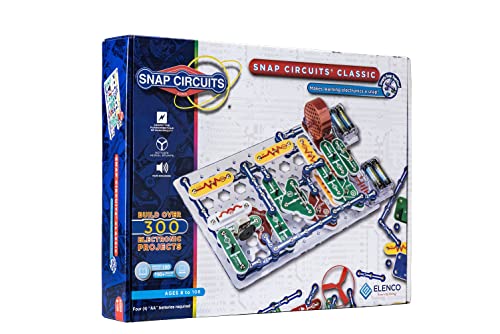
If you buy one electronic kit, buy this one. The genius of Snap Circuits is that the components snap onto a plastic grid like LEGO instead of needing wires, screws, or solder — so an eight-year-old builds a working circuit in minutes, not in tears. The SC-100 has the 100 projects most families actually finish: a doorbell, a flashing light, a siren, an electric fan that lifts off. The full-color manual draws each layout as a picture, which is the part that makes it work solo. It's the rare STEM toy where the kid does real electronics and stays hooked.

Builds: circuit basics · following diagrams · cause & effect

~$30· See it on Amazon
Beginner Electronics Exploration Kit (SCB-20)
Best for ages 5–7 · Snap Circuits

Beginner Electronics Exploration Kit (SCB-20)

The on-ramp for younger kids who aren't quite ready for the 100-project box. The parts are larger, the projects shorter, and the manual leans on big color pictures over text — so a five- or six-year-old can snap together a working fan or light and feel the same "I made it go" payoff. It's genuinely the same system as the bigger kits, so nothing they learn here gets wasted; you just graduate up a box when they're ready.

Builds: first circuits · fine motor · reading layouts

~$25· See it on Amazon
Classic SC-300 Electronics Exploration Kit
Best for the long haul · Snap Circuits

Classic SC-300 Electronics Exploration Kit

The upgrade pick, and the one a kid who's already hooked will live in. Over 300 projects — an AM radio, an adjustable light, an alarm with a photo-sensor — using the same snap parts plus a few more advanced components. This is where Snap Circuits stops being a novelty and starts teaching real ideas: what a transistor does, why a capacitor stores charge. If your child blew through a smaller kit, skip the in-between and get this; it has years of runway.

Builds: analog electronics · systematic building · persistence

~$58· See it on Amazon
Green Energy Electronics Exploration Kit
Best for renewable-energy fans · Snap Circuits

Green Energy Electronics Exploration Kit

A Snap Circuits set built entirely around where electricity comes from. The 125+ projects run on a solar panel, a hand crank, and a wind-turbine fan, so kids see power being generated rather than just drawn from a battery. It pairs naturally with school units on renewable energy, and it answers the "but where does the electricity actually come from?" question in a way a worksheet never will. Needs the same snap grid as the others, so it doubles as an expansion if you already own a kit.

Builds: solar & wind power · energy concepts · circuit building

~$44· See it on Amazon
Arcade Electronics Exploration Kit (SCA-200)
Best for gamers · Snap Circuits

Arcade Electronics Exploration Kit (SCA-200)

The kit for the kid who'd rather play games than "do science" — so it sneaks the science in. You build the working arcade games (a light-reflex test, a spinning prize wheel, a shooting target) and then actually play them, which means a child happily rebuilds and tweaks circuits for the payoff of a better game. It's the same snap system, just aimed at a kid who needs the fun front-loaded.

Builds: circuit logic · reaction & timing · hands-on play

~$42· See it on Amazon

First circuits for younger kids

For the five-to-seven crowd who aren't ready for a 100-project box. These wrap the circuit in a toy — a rover, a space scene — so the payoff is immediate and the building is forgiving.

Circuit Explorer Rover
Best first circuits (age 6) · Educational Insights

Circuit Explorer Rover

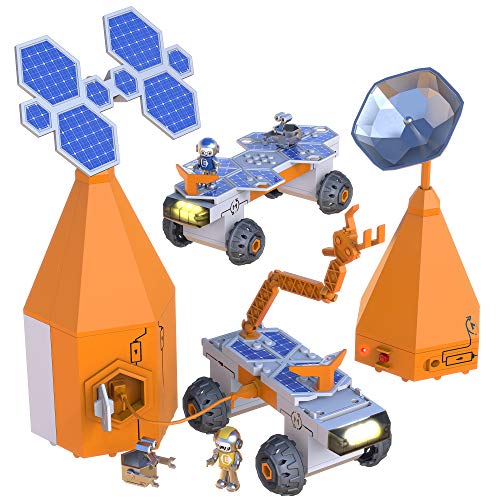
A gentler entry than Snap Circuits, and a clever one: kids wire up a space rover so its lights and a little motor actually work, then play with the finished toy. The circuit-building is simplified to colored connectors a six-year-old can manage, and because the reward is a glowing, buildable rover rather than a bare board, it keeps younger kids engaged who'd lose interest in pure electronics. A great bridge from "building toys" to "circuits."

Builds: simple circuits · lights & motors · imaginative play

~$26· See it on Amazon
Design & Drill Space Circuits
Best with a real toy drill · Educational Insights

Design & Drill Space Circuits

Two great kid-magnets in one box: a real kid-safe power drill and light-up circuits. Kids drive bolts to build a space scene, then complete circuits to make lights glow, working through 20 challenge cards. It's aimed squarely at the five-to-seven set, building the hand strength of the Design & Drill line with a first taste of "the light only comes on if the circuit is complete." Buzzy and hands-on rather than quiet and studious.

Builds: fine motor · circuit basics · following challenges

~$22· See it on Amazon

Beyond snap-together

Once a kid is hooked, these step up: their own modular systems, spring-terminal wiring, a real radio to build, and a budget board with actual wires. The next rung toward breadboards and schematics.

Circuit Maker Kit (60 Projects)
Best non-snap alternative · National Geographic

Circuit Maker Kit (60 Projects)

A solid alternative to Snap Circuits with its own modular pieces and 60 guided projects — useful if you want a second system, or simply prefer the National Geographic kit's look and instructions. Kids build alarms, lights, and sound circuits and learn the same core ideas (switches, resistors, what closes a circuit). The build manual is clear and the parts are sturdy; it's a genuine competitor rather than a knock-off.

Builds: circuit building · electronics vocabulary · following instructions

~$45· See it on Amazon
Electronic Playground 60-in-One
Best classic lab · Elenco

Electronic Playground 60-in-One

The old-school spring-terminal lab that a lot of engineers grew up on. Instead of snapping parts, kids run wires between spring terminals to build 60 projects — a radio, a lie detector, a metal sensor — which is a small step harder than Snap Circuits and a real taste of how breadboarding works. It's the pick for a kid who's outgrown snap kits and is ready to read a schematic and wire it themselves, without jumping all the way to soldering.

Builds: analog circuits · wiring with springs · reading schematics

~$36· See it on Amazon
Build Your Own FM Radio Circuit Kit
Best single-project build · E-Blox

Build Your Own FM Radio Circuit Kit

Sometimes one great finished thing beats a hundred quick projects. With these light-up brick-style circuit blocks, a kid builds a real working FM radio that tunes actual stations — the moment a station crackles in through a circuit they assembled themselves is genuinely thrilling. The 120-project version means it's not a one-and-done, but the radio is the hook. A focused, satisfying build for a child who likes finishing something real.

Builds: circuit assembly · how radio works · patience & focus

~$34· See it on Amazon
Circuit Board with Real Wires & Flying Fan
Best budget circuit set · Dr. STEM Toys

Circuit Board with Real Wires & Flying Fan

An honest, affordable circuit board for the kid who's curious but you're not sure it'll stick. Real wires, LED lights, and a fan that actually launches into the air across 18 experiments — enough to learn what a closed circuit is and watch a motor spin, without the price of a big-name kit. It's simpler and less polished than Snap Circuits, but it puts real wiring in a child's hands for a budget price, which is exactly the point.

Builds: real wiring · LED & motor basics · 18 experiments

~$26· See it on Amazon

A note on soldering kits

You'll see plenty of "electronics kits" online that require soldering — Elenco's AM/FM radio and learn-to-solder kits are well-made examples. We left them off this list on purpose: they're terrific for a motivated teen (or a parent and kid together), but a hot iron makes them the wrong gift for a young child working solo. Everything above is snap, clip, or spring-terminal — no iron required.

How much to spend

The $22–30 entry tier is where most first kits live — the Design & Drill Space Circuits, Snap Circuits Beginner, the Circuit Explorer Rover, and the Snap Circuits Jr. SC-100 all land here and any of them makes a generous gift. The $34–46 middle (Elenco Playground, Green Energy, the FM radio, National Geographic Circuit Maker) buys more projects or a special theme. And the one splurge that earns it is the Classic SC-300 — 300+ projects is years of play, so the cost-per-hour is tiny for a kid who's truly into it.

Frequently asked questions

What is the best electronic kit for kids?
For most kids, the Snap Circuits Jr. SC-100 is the best place to start — its components snap onto a grid instead of needing wires or solder, so a child builds a working circuit in minutes and the full-color manual lets them work mostly on their own. If your child is already hooked, jump to the Classic SC-300 (300+ projects) for years of runway. For ages 5–6, the Snap Circuits Beginner kit or Educational Insights Circuit Explorer Rover are gentler entries.
What age are electronic circuit kits good for?
Snap Circuits is officially rated 8+, and 8–9 is the sweet spot where kids can follow the layout diagrams independently. But there are real options younger: the Snap Circuits Beginner kit (ages 5–9) and Educational Insights Circuit Explorer Rover and Design & Drill Space Circuits (ages 5–6) use bigger parts and picture-only instructions. Spring-terminal labs like the Elenco Electronic Playground and FM-radio build kits suit older kids (9–12) ready for a bit more challenge.
Are Snap Circuits worth it?
Yes — they are the kit we recommend first, and the reason is the snap-grid design. Wires, screwdrivers, and solder are exactly where kids give up; snapping parts onto a grid removes that friction so the child spends their time on the actual electronics. The full-color manual draws each project as a picture rather than a schematic, so kids build successfully on their own. Because every kit shares the same parts, you can start small and expand without re-buying.
Do these kits need soldering?
None of the kits in this guide require soldering — that is deliberate. Snap Circuits, the Circuit Explorer sets, the National Geographic Circuit Maker, and the E-Blox radio all use snap connectors or clips, and the Elenco Electronic Playground uses spring terminals you wire by hand. All are safe and frustration-free for kids. Soldering kits exist (Elenco makes several) but are aimed at teens and adults, so we left them off a kids guide.
What do kids actually learn from electronic kits?
The core idea is that a circuit only works when it forms a complete loop — flip a switch or leave a gap and the light goes dark. From there kids meet the building blocks of electronics by feel, not memorization: switches, resistors, capacitors, motors, and how solar or a hand crank can power a circuit. Just as valuable is the habit the kits build — read a diagram, build it carefully, and troubleshoot when it doesn’t work the first time.

How we choose — and a word on the links

Educational Toys Planet has specialized in learning toys since 2004. We pick independently, only from established makers, then cross-check every candidate against current availability and the major independent award and expert lists. We don't accept payment for placement.

Affiliate disclosure: the product links here are Amazon Associate links. If you buy through them we may earn a small commission at no extra cost to you — that's what keeps these guides free and updated. Prices change; tap through for Amazon's current figure. Last updated June 2026.

Related guides