Best Educational Kits & STEM Toys for Kids (2026)

Educational kits work best when they feel like play — when a child doesn't realize they're learning chemistry while watching a crystal tower grow, or grasping renewable energy while a potato actually powers a clock. These picks span ages 5 to 12 and cover the sweet spots: science experiments, DIY engineering, space exploration, and hands-on art.

What separates a good kit from a forgettable one is whether a child can complete it with modest adult help, whether the result genuinely works, and whether there's real learning baked in — not just a finished toy. Every pick here meets that bar, and we've noted where age guidance is tight, where results can frustrate younger kids, and where re-playability is limited.

🧸 Curating learning toys since 2004 Independent picks · no pay-for-placement

Science Experiments

Kits that teach real chemistry, physics, or earth science through hands-on experiments kids can run themselves — expect some mess and some genuine wow moments.

KidzLabs Volcano Making Kit
Best classic first science experiment · 4M

KidzLabs Volcano Making Kit

The volcano eruption never gets old for 8–10-year-olds, and the kit includes enough material for multiple eruptions so the first failed attempt isn't the last. The molding step adds a craft layer that makes kids more invested in the experiment. It won't teach deep chemistry, but as a gateway to liking science, it earns its price. Adult supervision for the baking soda and vinegar ratio is helpful but not required.

Builds: Chemistry basics · Cause-and-effect thinking · Following multi-step instructions

~$14· See it on Amazon
Crystal Growing Science Kit – 3 Colored Crystals
Best budget crystal kit · 4M

Crystal Growing Science Kit – 3 Colored Crystals

Three separate crystal grows in three colors give kids natural comparison points, which is more educational than a single specimen. Results take several days, which is either a lesson in patience or a source of frustration depending on your child — worth setting expectations upfront. The display base is simple but functional. At this price, it's a low-risk introduction to chemistry for a 10-year-old who isn't sure yet if science is 'their thing.'

Builds: Patience and observation · Basic crystallography concepts · Recording changes over time

~$13· See it on Amazon
Clean Water Science – Climate Change & Global Warming Lab
Best for environmentally curious kids · 4M

Clean Water Science – Climate Change & Global Warming Lab

This kit tackles water filtration and desalination in a way that connects directly to real-world climate issues — rare for a kit at this price point. The experiments are genuinely informative rather than decorative. It skews toward curious 8–10-year-olds who already ask 'why' questions about the environment. The activities are less visually dramatic than crystal or volcano kits, so it suits kids who like reading and discussing results as much as the hands-on build.

Builds: Environmental science literacy · Critical thinking about global systems · Experimental design

~$15· See it on Amazon
Kidzlabs Anti Gravity Magnetic Levitation Science Kit
Best for mind-bending physics wow · 4M

Kidzlabs Anti Gravity Magnetic Levitation Science Kit

Watching an object hover without visible support genuinely stops kids in their tracks, and the kit explains the maglev physics clearly enough that it becomes a conversation starter. Assembly is fiddly — the levitation point is narrow and takes patience to find — so this is best for kids 9 and up even though it's rated 8+. Once it works, it holds attention far longer than a single-use experiment kit. The result is also displayable, which adds lasting value.

Builds: Magnetic field concepts · Fine motor precision · Persistence through fiddly assembly

~$22· See it on Amazon

DIY Engineering & Robotics

Build-it-yourself kits that result in something that actually moves, generates, or transmits power — mechanical wins that hold up past the first afternoon.

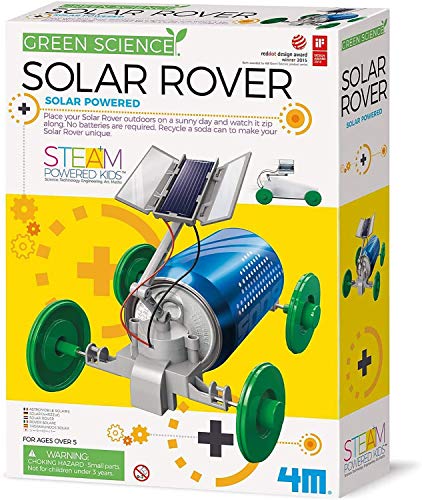
Green Science Solar Rover
Best outdoor STEM build for younger kids · 4M

Green Science Solar Rover

The rover actually moves under solar power, which makes the renewable energy lesson concrete rather than abstract — kids can block the panel with their hand and see it stop. It's genuinely accessible at age 5–6 with a parent helping, and older kids (7–8) can tackle most of it independently. Bright sunlight is required for best results, so overcast-climate families should know rainy-day demos will disappoint. Still one of the best introductions to solar energy available at this price.

Builds: Solar energy concepts · Basic mechanical assembly · Cause-and-effect with real-world systems

~$20· See it on Amazon
Hover Racer Science Kit – DIY Mechanical Engineering Airboat
Best for kids obsessed with how things move · 4M

Hover Racer Science Kit – DIY Mechanical Engineering Airboat

The airboat design is genuinely clever — it uses a small fan motor to glide on smooth surfaces, and kids can experiment with weight distribution to change its behavior. Assembly is straightforward for an 8-year-old with some kit experience, and the finished toy holds up to repeated play rather than being a one-and-done display piece. It requires batteries (not included), which is worth noting. Best on hard floors; carpet kills the fun.

Builds: Aerodynamics basics · Motor mechanics · Spatial reasoning during assembly

~$17· See it on Amazon
Kidzlabs Robotic Hand Kit
Best introduction to biomechanics · 4M

Kidzlabs Robotic Hand Kit

The hand mimics real tendon mechanics using strings, which makes it a surprisingly effective lesson in how human anatomy works — something kids genuinely find cool rather than textbook-dry. Assembly takes 30–45 minutes for most 8-year-olds. The finished hand is grippable and interactive, which means it gets used after the first day. A few small parts make it unsuitable for younger siblings hovering nearby.

Builds: Understanding tendons and joints · Fine motor skills during assembly · Engineering problem-solving

~$13· See it on Amazon

Space & Astronomy

Glow-in-the-dark planets, string lights, and planetarium models that make the solar system tangible for kids who look up at the sky and ask questions.

3D Glow-in-the-Dark Solar System Mobile Making Kit
Best hanging solar system for a kid's room · 4M

3D Glow-in-the-Dark Solar System Mobile Making Kit

The finished mobile genuinely looks good in a bedroom, which means kids interact with the planets long after the build day. Painting the planets requires care — rushing produces muddy colors — so this suits kids willing to slow down and do it properly. The glow charge works well with a few seconds under a lamp. At 8+ the age guidance is accurate; younger kids will want significant help with the hanging mechanism. A solid gift that doubles as room decor.

Builds: Planetary order and relative size · Fine motor skills during painting · Astronomy curiosity

~$23· See it on Amazon
Solar System Planetarium – DIY Glow In The Dark Planet Model
Best desktop solar system model · 4M

Solar System Planetarium – DIY Glow In The Dark Planet Model

A tabletop alternative to a hanging mobile, this kit results in a displayable model that kids can pick up and examine. The glow effect is satisfying and helps reinforce which planet is which after the lights go out. It's a step up in accuracy from glow stickers while being more approachable than a complex planetarium projector. Paints require some care; the included brush is thin, so a slightly wider spare brush improves results.

Builds: Planetary science · Painting and detailing patience · Spatial understanding of the solar system

~$17· See it on Amazon

Arts, Crafts & Creative Kits

Craft kits with enough structure to finish successfully and enough creative freedom to feel personal — not just color-by-number busywork.

Green Creativity Pressed Flower Art Kit
Best calm, nature-connected craft for ages 5+ · 4M

Green Creativity Pressed Flower Art Kit

Pressing flowers requires waiting, which makes this a kit that plays out over days rather than an afternoon — genuinely different from instant-gratification crafts. The included materials are enough for multiple projects, and the results are display-worthy. This works well for kids who like the outdoors and making things that last. Parents should expect to help source fresh flowers; the kit itself doesn't include them, which isn't obvious from the packaging.

Builds: Botanical observation · Patience and planning · Artistic composition

~$17· See it on Amazon
Kidzlabs Kaleidoscope Making Kit
Best craft-meets-optics kit · 4M

Kidzlabs Kaleidoscope Making Kit

Building a kaleidoscope that actually produces the classic pattern is more satisfying than it sounds, and the optical explanation included is clear enough for a 7-year-old to grasp. The decorating step gives it a personal, craft-project feel alongside the science angle. It's a one-time build rather than a repeatable experiment, but the finished object genuinely gets used as a toy. A good pick for kids who like both making things and figuring out how they work.

Builds: Understanding light and reflection · Fine motor construction skills · Curiosity about optics

~$15· See it on Amazon
Make A Wind Chime Kit – Arts & Crafts Construct & Paint
Best starter craft for ages 4–6 · 4M

Make A Wind Chime Kit – Arts & Crafts Construct & Paint

At under $11, this is a genuinely low-risk first kit for preschool and early elementary kids. The result actually functions as a wind chime, which matters — kids are far more engaged with something they can hang up and hear than a purely decorative project. Painting is simple enough for a 4-year-old with minimal help. The materials are basic but sufficient, and the instructions are clear. Don't expect heirloom quality; expect a proud kid and an afternoon well spent.

Builds: Fine motor painting skills · Listening and sound awareness · Pride in completed functional object

~$11· See it on Amazon

How we choose — and a word on the links

Educational Toys Planet has specialized in learning toys since 2004. We pick independently, only from established makers, then cross-check every candidate against current availability and the major independent award and expert lists. We don't accept payment for placement.

Affiliate disclosure: the product links here are Amazon Associate links. If you buy through them we may earn a small commission at no extra cost to you — that's what keeps these guides free and updated. Prices change; tap through for Amazon's current figure. Last updated June 2026.

Related guides