Best Solar System Exploration Toys for Kids (2026)

Whether your kid wants to hang planets above their bed or build a Mars rover on the living room floor, solar system toys have come a long way from styrofoam-ball dioramas. The picks below cover a real range of learning styles, budgets, and ages — from a $16 paint-your-own planetarium to a $135 LEGO launchpad that takes a full weekend to build.

The best solar system toys do two things: they get the scale and the science roughly right, and they give kids something to do with their hands. We skipped the purely decorative and anything that just flashes lights with no learning payoff, favoring kits that ask kids to assemble, problem-solve, or create.

🧸 Curating learning toys since 2004 Independent picks · no pay-for-placement

Build & Display Models

Kits you assemble and keep — mobiles, planetariums, and string lights that turn a bedroom ceiling into a mini observatory.

3D Glow-in-the-Dark Solar System Mobile Making Kit
Best ceiling mobile for ages 8+ · 4M

3D Glow-in-the-Dark Solar System Mobile Making Kit

Kids punch out and assemble 3D planet forms, paint them, and hang a genuine mobile — no pre-assembled shortcuts. The glow effect is satisfying at night, and the relative sizing of the planets prompts real questions. The painting step can get messy, so lay down newspaper; the included paints are thin and may need a second coat.

Builds: Fine motor skills · Spatial reasoning · Astronomy basics

~$23· See it on Amazon
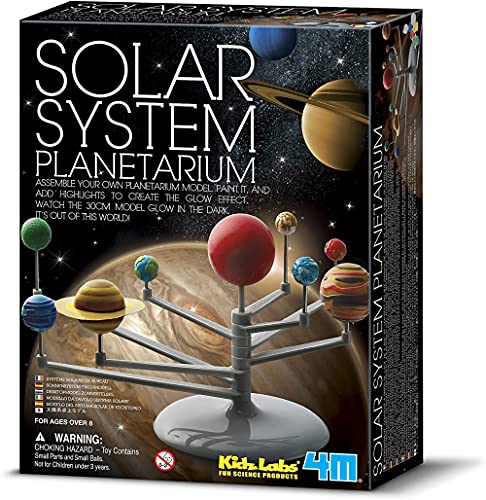
Solar System Planetarium – DIY Glow In The Dark Planet Model
Best budget planetarium kit · 4M

Solar System Planetarium – DIY Glow In The Dark Planet Model

At under $17, this is the most affordable way to get a complete, displayable solar system model. Kids paint and position planets on a wire armature that shows orbital paths. The wire can be fiddly for younger hands, so expect to assist children under 9. Doesn't include a stand — plan to hang it or prop it on a shelf.

Builds: Assembly skills · Astronomy concepts · Patience

~$17· See it on Amazon
STEAM Powered Girls Solar System String Lights – Mini-Planetarium DIY
Best for younger builders who want a glowing room feature · 4M Toysmith

STEAM Powered Girls Solar System String Lights – Mini-Planetarium DIY

Planet covers slide over individual string lights to create a soft, planet-themed glow — genuinely pretty in a darkened room. The assembly is simpler than the mobile kits, making it more appropriate for the 5–7 range even though it's marketed broadly. The light strand is battery-powered and short, so it works best as a desk accent rather than a full room feature.

Builds: Creativity · Basic planet recognition · Following instructions

~$17· See it on Amazon
GeoSafari® Orbiting Solar System & Projector
Best interactive projector for young learners · Educational Insights

GeoSafari® Orbiting Solar System & Projector

This is the pick for kids who learn by watching and interacting rather than building. The motorized orbiting arm shows planets in motion around the sun, and the projector throws space imagery on walls or ceilings. At $45 it's the pricier option in this tier, but it's the only pick here that demonstrates orbital motion kinetically rather than statically. Works best in a dimmed room.

Builds: Astronomy concepts · Cause-and-effect thinking · Observational skills

~$45· See it on Amazon
Solar System Science Kit
Best for creative kids who want to paint and learn · Crayola

Solar System Science Kit

Crayola's kit combines the familiar comfort of their art supplies with basic solar system facts, letting kids paint planet models while absorbing information about each one. It's lighter on the STEM rigor than the 4M kits but lower-stress for kids who find step-by-step assembly frustrating. A good choice for ages 7–9 who lean artistic; the finished models are display-worthy and genuinely colorful.

Builds: Creativity · Planet facts · Fine motor skills

~$16· See it on Amazon

LEGO Space Sets

Brick-based builds that cover everything from rocket launchpads to Mars rovers, with varying complexity by age.

City Modular Space Station STEM Toy
Best LEGO space set for ages 7–9 · LEGO

City Modular Space Station STEM Toy

The modular design means sections can be rearranged, which extends play well beyond the initial build and encourages kids to experiment with layouts. Six minifigures give it strong role-play potential. It's a substantial build at this price point — expect 2–3 hours of focused assembly for a 7-year-old. Not the cheapest entry, but it holds up to repeated play better than many sets.

Builds: Engineering thinking · Sequencing · Creative play

~$88· See it on Amazon
City Space Base and Rocket Launchpad
Best big-ticket LEGO space set · LEGO

City Space Base and Rocket Launchpad

This is the room-centerpiece set for a dedicated space kid — a full launchpad with a working rocket that actually lifts on its stand, plus a sprawling base for extended astronaut adventures. The piece count and complexity suit ages 8 and up comfortably; younger kids will need a co-builder. The price is real, but it consistently holds a child's attention across many play sessions, not just the build day.

Builds: Advanced building skills · Narrative play · Persistence

~$135· See it on Amazon
Technic Mars Crew Exploration Rover Building Set
Best for budding engineers aged 10+ · LEGO

Technic Mars Crew Exploration Rover Building Set

Technic gearing and functional steering mechanisms make this feel genuinely different from a standard brick set — kids see how wheels turn and suspension works. The Mars theme is well-executed and connects naturally to real rover missions kids may know from news or school. It's a challenging build that rewards patience; not appropriate for kids under 10 without significant adult help.

Builds: Mechanical reasoning · Problem-solving · Attention to detail

~$102· See it on Amazon
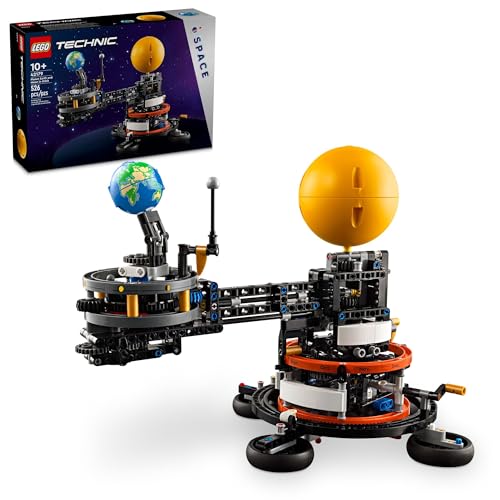
Technic Planet Earth and Moon in Orbit Building Set
Best for visualizing Earth-Moon mechanics · LEGO

Technic Planet Earth and Moon in Orbit Building Set

The finished model shows the Moon orbiting Earth with a hand-cranked mechanism that demonstrates rotation and orbit simultaneously — a concept kids often struggle to visualize. It's a display piece as much as a toy, which suits older kids (10+) who like shelf-worthy builds. Smaller and less play-oriented than the launchpad or rover, but uniquely educational in what it demonstrates.

Builds: Spatial reasoning · Astronomy concepts · Mechanical understanding

~$71· See it on Amazon

Puzzles & Classroom Tools

Hands-on learning aids — puzzles, magnetic boards, and NASA photography — that work as well in a classroom as at home.

Solar System Puzzle – Round Wooden Glow-in-the-Dark
Best solar system puzzle for ages 5+ · Hape

Solar System Puzzle – Round Wooden Glow-in-the-Dark

Solid wood pieces with a round format that mirrors the sun-centered layout of the solar system — smarter design than a rectangular space-scene puzzle. Pieces are chunky enough for younger kids, and the glow-in-the-dark feature makes charging it under a lamp and then turning off the lights a satisfying ritual. Some parents find the glow fades faster than expected; it needs a bright light source to charge well.

Builds: Spatial reasoning · Planet recognition · Fine motor skills

~$23· See it on Amazon
Mars 100 Piece Puzzle – NASA Photography
Best for real NASA photography and older kids · Chronicle Books

Mars 100 Piece Puzzle – NASA Photography

This shaped puzzle uses actual NASA archive photography of Mars — craters, dunes, and rust-colored plains — rather than illustrated art. For kids who've moved past cartoon planets into genuine curiosity about what Mars looks like, it's a meaningful step up. The 100-piece count and shaped silhouette make it approachable from age 6, though the photographic imagery (no bright colors) makes it more engaging for 8+ kids.

Builds: Visual perception · Patience · Science literacy

~$20· See it on Amazon
Giant Magnetic Solar System Whiteboard Display
Best classroom or homeschool teaching tool · Learning Resources

Giant Magnetic Solar System Whiteboard Display

Thirteen magnetic pieces — the eight planets, the sun, plus a few extras — stick to any whiteboard or magnetic surface and let kids physically arrange and rearrange the solar system. At $16 it's a genuinely low-cost classroom resource, and it works for ages 5 and up. The pieces are flat and labeled, so it's more of a teaching aid than a toy; pair it with a model kit for kids who want something three-dimensional.

Builds: Planet sequencing · Relative size concepts · Group learning

~$16· See it on Amazon

How we choose — and a word on the links

Educational Toys Planet has specialized in learning toys since 2004. We pick independently, only from established makers, then cross-check every candidate against current availability and the major independent award and expert lists. We don't accept payment for placement.

Affiliate disclosure: the product links here are Amazon Associate links. If you buy through them we may earn a small commission at no extra cost to you — that's what keeps these guides free and updated. Prices change; tap through for Amazon's current figure. Last updated June 2026.

Related guides